
Jinshanling Great Wall, Beijing
The Jinshanling Great Wall is the wildest Ming section of the Great Wall near Beijing. It runs for about 10.5 km across the ridges of Hebei province.
The Jinshanling Great Wall was rebuilt in 1567 to 1570 under General Qi Jiguang, and it has been left far less restored than the famous sections at Badaling and Mutianyu. Its 67 watchtowers, five passes and three beacon towers stand on a ridge about 700 m above sea level, and the walk along the Jinshanling Great Wall takes half a day, or a full day if you continue to the Simatai section. The Jinshanling Great Wall is the section for walkers who want the Wall as it was, with broken brick, steep climbs and empty towers.
Quick Facts
| Item | Detail |
|---|---|
| Name | Jinshanling Great Wall (in Chinese, Jinshanling Changcheng) |
| Location | Luanping County, Chengde, Hebei province, about 125 km north-east of Beijing |
| Type | Ming dynasty section of the Great Wall |
| Rebuilt | 1567 to 1570, under General Qi Jiguang |
| Length | About 10.5 km, with 67 watchtowers, 5 passes and 3 beacon towers |
| Altitude | About 700 m above sea level |
| Coordinates | 40.6788 N, 117.2508 E |
| Wikidata | Q1689619, Jinshanling, a section of the Great Wall |
| UNESCO | Part of the Great Wall, listed in 1987, reference 438, criteria (i), (ii), (iii), (iv) and (vi) |
| Highlights | Wild, little-restored wall; the walk to Simatai; sunset over the ridges |
| Best season | April to May and September to October, for clear air and mild weather |
The Jinshanling Great Wall stands in the mountains of Luanping County, in Chengde, Hebei province, about 125 km north-east of Beijing. The Wall runs along a ridge that divides the valleys, and the land falls away on both sides into farmland and forest. The section is far from the city, and the journey from Beijing takes about two to three hours by road, through the hills that ring the capital.
The ridge of the Jinshanling Great Wall is high and exposed. The Wall follows the crest from tower to tower, climbing and falling with the ground, and the views run for kilometres across the mountains of northern Hebei. The towers stand at intervals along the ridge, and between them the Wall is a narrow walkway of brick and stone, with broken sections and steep steps. The site is quiet, and on a weekday you can walk for an hour without meeting another person.
Geography
The Jinshanling Great Wall runs along a mountain ridge in northern Hebei, at about 700 m above sea level, in the Yanshan mountains that guard the northern approach to Beijing. The ridge is a natural line of defence: it rises above the valleys on both sides, and the Wall follows its crest, so that the towers command the passes below. The land around the Jinshanling Great Wall is a mix of forest, farmland and bare rock, and the villages in the valleys are small and quiet, with fields of corn and orchards of fruit trees.
The Wall at Jinshanling is about 10.5 km long, with 67 watchtowers, five passes and three beacon towers. The towers are of several kinds: some are square, some are round, and some have two storeys, with rooms for soldiers and stores. The passes are the gates through the Wall, where roads once crossed the ridge, and the beacon towers stand on the highest points, where fires once warned of attack. The Wall is built of brick and stone, with a walkway on top that is wide enough for two people to pass, and the brick is weathered and broken in places, which is part of the appeal of the Jinshanling Great Wall.
The seasons change the Jinshanling Great Wall more than any other section. In spring, from April to May, the hills are green and the air is clear, and the Wall is at its best for walking. Summer brings heat and rain, and the ridge is exposed to the sun, so the walk is hard in the middle of the day.
Autumn, from September to October, is the finest season, with clear skies, cool air and the hills turning gold and red. Winter brings cold wind and snow, and the Wall is empty then, with the brick white against the dark hills.
The walk from Jinshanling to Simatai is the great walk of the Jinshanling Great Wall. The route runs about 10 km along the ridge, and it takes four to five hours, crossing from the restored towers of Jinshanling to the wild towers of Simatai. The path is rough, with broken brick and steep steps, and there are no shops on the Wall, so walkers carry water and food. The far end of the route, at Simatai, is reached by a cable car or by a long descent to the valley, and the walk is the reason most people come to Jinshanling.
The ridge of the Jinshanling Great Wall is also a watershed, and the valleys on its two sides drain in different directions, towards the Luan River and towards the plains of Beijing. The villages in those valleys are small, and their fields climb the lower slopes in terraces, with corn, millet and fruit trees. The Wall above them is a reminder of a time when the ridge was a frontier, and the villages below it lived under its protection, supplying the garrisons with food and labour. Today the villages live from farming and from the visitors who walk the Jinshanling Great Wall, and the guesthouses at the foot of the ridge are the base for the walk.
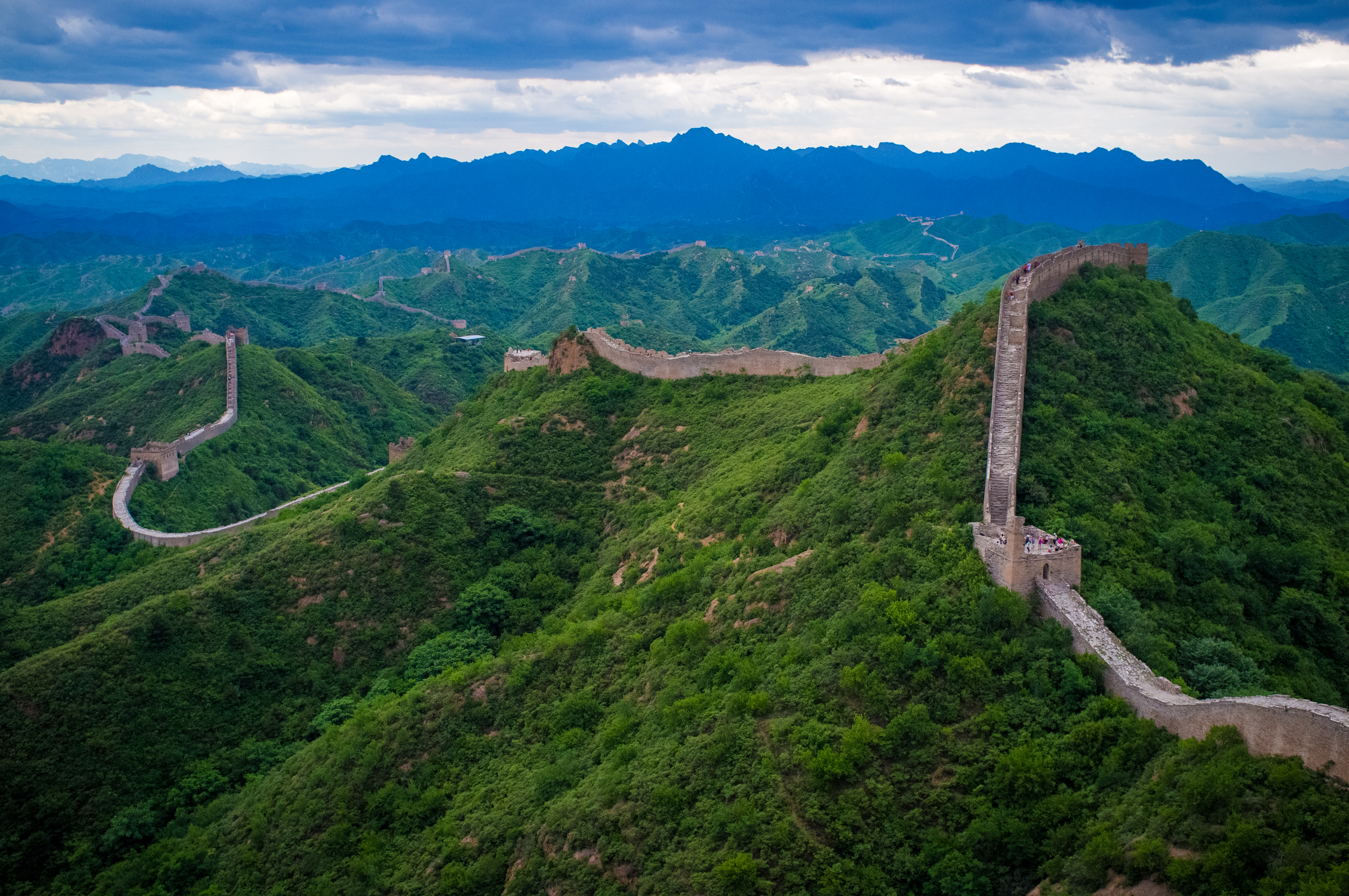
The Great Wall at Jinshanling runs across the hills of Hebei — CC BY-SA 3
History
The Great Wall was built over two thousand years, from the 3rd century BCE to the 17th century CE, as the great military defence of successive Chinese empires, and its total length is more than 20,000 km. The section at Jinshanling belongs to the Ming dynasty, the last great building of the Wall, when the empire faced the Mongols to the north. The original Ming wall at Jinshanling was thin and weak, and in 1567 the general Qi Jiguang was given command of the northern frontier and ordered to rebuild it.
Qi Jiguang rebuilt the Jinshanling Great Wall between 1567 and 1570, making it one of the strongest sections of the Ming wall. He raised the height of the wall, built the 67 watchtowers in brick, and added the passes and beacon towers that still stand today. The towers were designed for defence in depth: soldiers could fire from the towers, retreat along the wall and hold the passes, and the beacon fires could warn Beijing of an attack within hours. The work of Qi Jiguang is the reason the Jinshanling Great Wall still stands, and his name is still linked to the section.
After the Ming dynasty fell in 1644, the Jinshanling Great Wall lost its military purpose, and the Wall was left to the weather. The garrisons left, the villages in the valleys turned to farming, and the brick and stone of the Wall were slowly broken by wind, rain and frost. The section was never restored in the way that Badaling was, and it stayed a ruin, with broken towers and empty passes, for more than three centuries.
In the 20th century the Jinshanling Great Wall became known to walkers and photographers, who valued it precisely because it had not been rebuilt. The Wall was listed by UNESCO in 1987, as part of the Great Wall, reference 438, criteria (i), (ii), (iii), (iv) and (vi), and the Jinshanling Great Wall has no reference of its own. The listing covers the whole Wall, from Shanhaiguan in the east to Jiayuguan in the west, and Jinshanling is one of its best-preserved Ming sections.
Today the Jinshanling Great Wall is managed as a scenic area, with a cable car, a ticket office and a path to the Wall, but the Wall itself is left largely as it was. The towers are not rebuilt, the brick is not replaced, and the walk is the same rough walk that walkers have made for decades. The section is the quiet alternative to Badaling, and it draws the travellers who want the Wall without the crowds.
The care of the Jinshanling Great Wall follows the law of 2006, the Regulations on the Protection of the Great Wall, which is the specific legal document for the conservation of the Wall. The regulations cover the whole Wall, and they set the rules for repair, for building near the Wall and for the work of the local governments that guard it. At Jinshanling the rules mean that the Wall is kept as a ruin, with repairs only where a tower is in danger of falling, and the ridge stays free of the hotels and cable cars that crowd the restored sections.
Timeline
- 3rd century BCE to 17th century CE: the Great Wall is built over two thousand years, with a total length of more than 20,000 km.
- 1567 to 1570: General Qi Jiguang rebuilds the Jinshanling Great Wall, with 67 watchtowers, five passes and three beacon towers.
- 1644: the Ming dynasty falls, and the Jinshanling Great Wall loses its military purpose.
- 1987: UNESCO lists the Great Wall as a World Heritage site, reference 438, with the Jinshanling Great Wall as part of the property.
- 2006: China issues the Regulations on the Protection of the Great Wall, the specific law for the conservation of the Wall.
- Today: the Jinshanling Great Wall is managed as a scenic area, with the Wall left largely unrestored.
Travel
Come to the Jinshanling Great Wall in April to May or in September to October, when the air is clear and the weather is mild. Spring brings green hills and cool mornings, and autumn brings gold and red leaves and the clearest skies of the year. Summer is hot, and the ridge is exposed to the sun, so start early and carry water. Winter is cold and windy, and the Wall is empty then, but the brick can be icy underfoot, so wear shoes with grip.
Allow at least half a day for the Jinshanling Great Wall. The cable car or the walk from the gate takes 20 to 30 minutes to reach the Wall, and the short walk from the main gate to the middle towers and back takes about two to three hours. The full walk to Simatai takes four to five hours, and it is a whole day with the journey from Beijing. Carry water, food, a hat and good walking shoes, because there are no shops on the Wall, and the brick is broken and steep in places.
Reach the Jinshanling Great Wall from Beijing by car or by bus, a journey of about two to three hours through the hills north-east of the capital. The site has a ticket office and a cable car, and the ticket price and the opening hours change from time to time, so check the official information before you go. The Wall is open through the day, roughly from 7 in the morning to 6 in the evening, with an earlier close in winter, and you should confirm the hours at the gate on the day.
Walk the Jinshanling Great Wall slowly, and watch your footing on the broken brick and the steep steps. The towers are the best places to rest, and the middle towers give the finest views along the ridge. Do not climb on the broken walls or take bricks as souvenirs, because the Wall is a protected site. The sunset from the Jinshanling Great Wall is one of the great sights of northern China, and it is worth timing the walk to end as the light turns gold on the ridges.
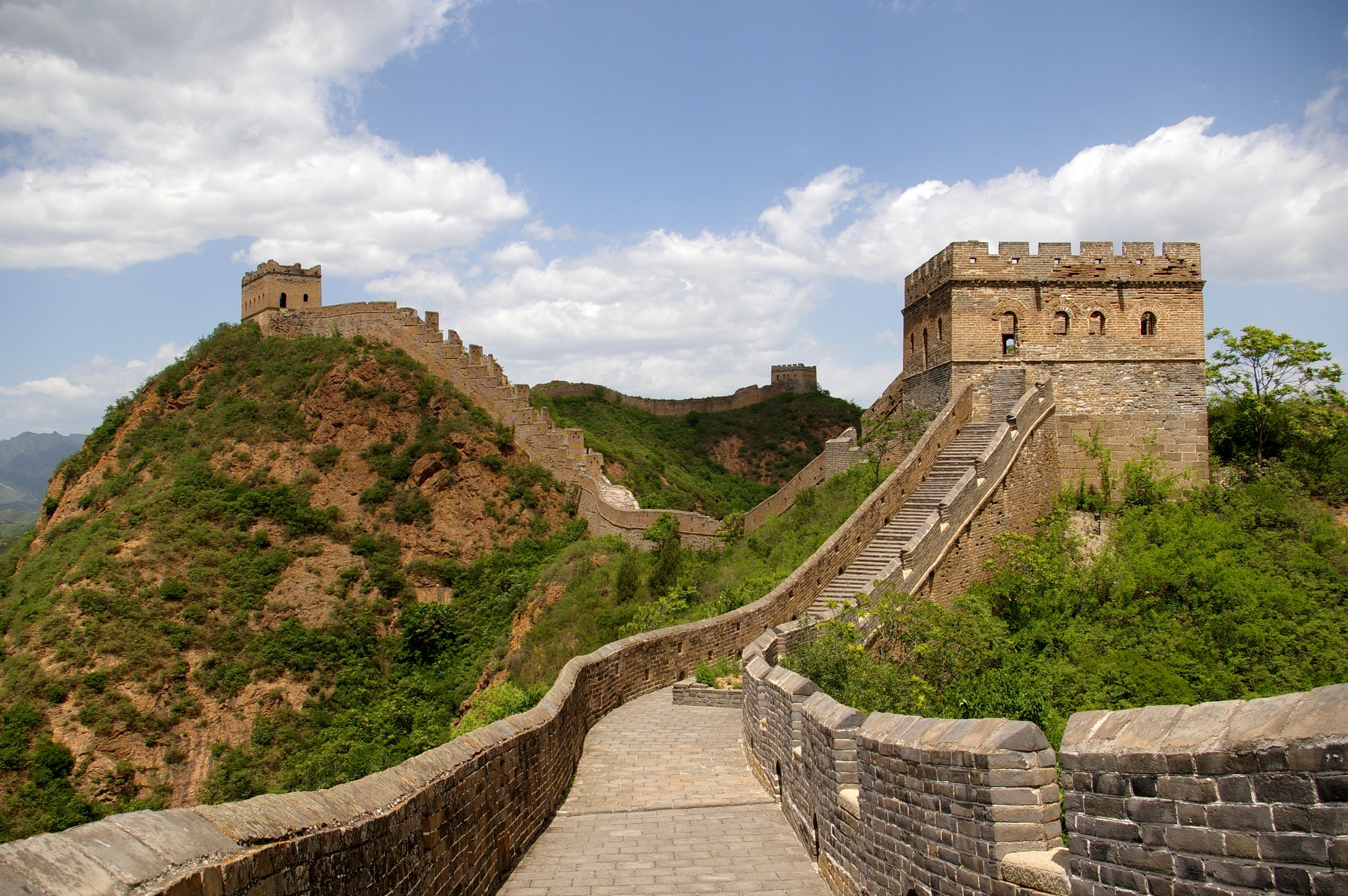
The Great Wall climbs the mountain ridges at Jinshanling — CC BY-SA 3
Notable Places
The middle towers of the Jinshanling Great Wall are the heart of the walk, and they give the finest views along the ridge. The towers stand on the highest part of the Wall, and from them you can see the Wall running away in both directions, tower after tower, across the hills. The brick is weathered and broken here, and the towers are empty, with rooms for soldiers and stores that have stood open to the sky for centuries.
The five passes of the Jinshanling Great Wall are the gates through the Wall, where roads once crossed the ridge, and they are the places where the defence of the Wall was strongest. The passes are wider than the walkway, with walls and towers on both sides, and they show how the Wall worked as a frontier, not only as a barrier. The beacon towers stand on the highest points of the ridge, where fires once warned Beijing of an attack, and they are the most exposed and the most dramatic places on the Jinshanling Great Wall.
The walk to Simatai is the great route of the Jinshanling Great Wall, and it runs about 10 km along the ridge to the east. The route crosses from the towers of Jinshanling to the wilder towers of Simatai, and the path grows rougher as it goes, with broken brick and steep steps. The end of the route, at Simatai, is reached by a cable car or by a long descent to the valley, and the walk is the reason most people come to Jinshanling.
Mutianyu Great Wall and Badaling Great Wall are the restored sections of the Wall near Beijing, and Beijing is the city that the Wall was built to protect. The three sections together show the range of the Wall, from the rebuilt grandeur of Badaling to the wild ruin of Jinshanling, and the Jinshanling Great Wall is the section for walkers who want the Wall as it was.
Frequently Asked Questions
How long is the Jinshanling Great Wall?
The Jinshanling Great Wall is about 10.5 km long, with 67 watchtowers, five passes and three beacon towers, and it stands on a ridge about 700 m above sea level. The walk along the Jinshanling Great Wall takes half a day, or a full day if you continue to the Simatai section.
How far is the Jinshanling Great Wall from Beijing?
The Jinshanling Great Wall lies about 125 km north-east of Beijing, in Luanping County, Chengde, Hebei province. The journey from Beijing takes about two to three hours by road, through the hills that ring the capital.
Is the Jinshanling Great Wall a UNESCO World Heritage site?
The Jinshanling Great Wall has no UNESCO title of its own, but it is part of the Great Wall, listed by UNESCO in 1987, reference 438, criteria (i), (ii), (iii), (iv) and (vi). The listing covers the whole Wall, from Shanhaiguan in the east to Jiayuguan in the west, and the Jinshanling Great Wall is one of its best-preserved Ming sections.
When is the best time to visit the Jinshanling Great Wall?
April to May and September to October are the best months, with clear air and mild weather. Spring brings green hills, and autumn brings gold and red leaves and the clearest skies of the year. Summer is hot, and winter is cold and windy, with the brick icy underfoot.
How long does the walk from Jinshanling to Simatai take?
The walk from Jinshanling to Simatai runs about 10 km along the ridge, and it takes four to five hours. The path is rough, with broken brick and steep steps, and there are no shops on the Wall, so carry water and food. The far end, at Simatai, is reached by a cable car or by a long descent to the valley.
Who rebuilt the Jinshanling Great Wall?
The rebuilding was the work of General Qi Jiguang, who commanded the Ming northern frontier. Between 1567 and 1570 he heightened the wall, raised its 67 watchtowers in brick, and built the passes and beacon towers that stand today.
Verified
- Jinshanling Great Wall facts in this article were checked on 20 November 2026 against the verified Vietnamese article for the Jinshanling Great Wall and the official UNESCO list page for the Great Wall, reference 438, at https://whc.unesco.org/en/list/438/, which records the Wall at more than 20,000 km, built from the 3rd century BCE to the 17th century CE, and listed under criteria (i), (ii), (iii), (iv) and (vi).
- The Jinshanling Great Wall lies about 125 km north-east of Beijing, runs about 10.5 km, has 67 watchtowers, five passes and three beacon towers, and stands at about 700 m above sea level, as recorded in the verified Vietnamese article for the Jinshanling Great Wall.
- The Jinshanling Great Wall was rebuilt in 1567 to 1570 under General Qi Jiguang, and the walk from Jinshanling to Simatai runs about 10 km and takes four to five hours, as recorded in the verified Vietnamese article for the Jinshanling Great Wall.
- The Wikidata record Q1689619 gives Jinshanling, with coordinates 40.678766 and 117.25084, matching the registry.
- The English keyword group for the Jinshanling Great Wall in the grouping file gom-nhom-4182 contains two keywords, but the extractor returned no rows for this entity, so this article uses the registry primary keyword and the keyword list recorded in the Vietnamese article.
Sources
- UNESCO, The Great Wall, official list page: https://whc.unesco.org/en/list/438/
- Wikipedia, Jinshanling: https://en.wikipedia.org/wiki/Jinshanling
- TheTerraAtlas Vietnamese article for the Jinshanling Great Wall (jinshanling-great-wall.vi.md), facts verified in that article with sources and check dates.
Unverified
- The ticket price and the cable car price for the Jinshanling Great Wall change from time to time and were not verified on the official site for this article; check the official information before you go.
- The opening hours of the Jinshanling Great Wall, about 7 in the morning to 6 in the evening, with an earlier close in winter, should be confirmed at the gate on the day.
- The state of the link between Jinshanling and Simatai changes with restoration work, and visitors should ask at the gate on the day before setting out.
- The figures of 67 watchtowers, five passes and three beacon towers and the length of 10.5 km come from the sources and may differ with counting.
- The years of the rebuilding under Qi Jiguang, 1567 to 1570, follow one source, while other sources give a building period running into the early 1570s.
- The registry records this entity with no UNESCO title of its own; whether the registry should mark it as part of the Great Wall property is a question for the fix queue, not a fact stated in this article.
Illustrations
- Hero: View of Jinshanling Great Wall, Beijing. Free image: https://upload.wikimedia.org/wikipedia/commons/4/45/Jinshanling_Great_Wall%2C_near_Beijing%2C_2026_%282%29.jpg — CC BY 4.0.
- In body, wall: The Great Wall climbs the mountain ridges at Jinshanling Free image: https://upload.wikimedia.org/wikipedia/commons/5/50/20090529_Great_Wall_8125.jpg — CC BY-SA 3.
- In body, wall: The Great Wall at Jinshanling runs across the hills of Hebei Free image: https://upload.wikimedia.org/wikipedia/commons/6/6f/The_Great_Wall_of_China_at_Jinshanling.jpg — CC BY-SA 3.