
Constitution Hill — From Johannesburg’s Most Notorious Prison to its Highest Court
Constitution Hill in Johannesburg was once the most notorious prison in South Africa. Today it holds the Constitutional Court.
Constitution Hill in Johannesburg is a place where the history of South Africa turns on itself: a hill that held the most notorious prison of the country, and that now holds the Constitutional Court, the highest court of the land. The Old Fort, built in eighteen ninety-three, the Number Four prison for black men, and the Women’s Jail, built in nineteen ten, held thousands of people under apartheid, including Mahatma Gandhi and Nelson Mandela, and the prison closed in nineteen eighty-three. The Constitutional Court was inaugurated on the same hill on the twenty-first of March two thousand and four, and the hill opened to the public the next day, as a museum, as a court, and as a place of memory. This guide explains Constitution Hill: the prison, the court, and the visit, and how the hill changed from a place of punishment to a place of law.
Quick Facts
- Place: A historic complex on a hill in Braamfontein and Hillbrow, in inner-city Johannesburg, South Africa.
- History: The Old Fort built from eighteen ninety-three; the prison closed in nineteen eighty-three; the Constitutional Court inaugurated on the twenty-first of March two thousand and four.
- Prisons: The Old Fort, Number Four, the Women’s Jail, and the Awaiting Trial Block, all on the same hill.
- Prisoners: Mahatma Gandhi, held in the Old Fort in nineteen hundred and six and in nineteen thirteen; Nelson Mandela, held in the Awaiting Trial Block in the nineteen fifties.
- UNESCO: Component one six seven six dash zero zero nine of the Human Rights, Liberation and Reconciliation: Nelson Mandela Legacy Sites, ref one six seven six, inscribed two thousand and twenty-four, criteria (vi), five point three four hectares.
- Court: Designed by OMM Design Workshop and Urban Solutions, who won the design competition in nineteen ninety-eight; the building covers eight thousand one hundred and seventy-eight square metres on three floors.
- Opened: The complex opened to the public on the twenty-second of March two thousand and four, the day after the court was inaugurated.
- Visit: Allow two to three hours, with a guided tour, starting at the Old Fort and ending at the court.
Geography of Constitution Hill
Constitution Hill stands on a hill in Braamfontein and Hillbrow, in inner-city Johannesburg, and it is one of the highest points of the inner city, with the walls of the Old Fort looking down over the streets around it. The hill is part of the history, because the fort was built on the hill to defend the town, and because the prison was built on the hill to cut the prisoners off from the city, and because the court was built on the hill to be seen, and to be reached, by all. The coordinates of Constitution Hill are about twenty-six degrees and eleven minutes south, and twenty-eight degrees and three minutes east, and the complex is close to the centre of the city, so that it can be reached by car or by bus, and even on foot from the centre, although travellers should be careful about security in the evening. The hill is the geography of the place, and the view from it, over the city, is the view that the prisoners never had, and that the judges now have.
The complex holds three notorious prisons, all on the same hill, and each with its own history, and each with its own people. The Old Fort, from eighteen ninety-three, was first a prison for all male prisoners, and then, under the Union and under apartheid, mainly for white prisoners, with the cells and the isolation cells that held the men who were punished most. Number Four, built in the nineteen thirties and forties, was the prison for black men, and it was the most notorious of the three, with overcrowded cells, and with poor sanitation, and with the brutal treatment that made it a symbol of the racial prison system. The Women’s Jail, built in nineteen ten, held women of every racial classification, with the same poor conditions, and with the women who had been arrested for their part in the resistance.
The Awaiting Trial Block held the prisoners before they went to court, including Nelson Mandela in the nineteen fifties. The four buildings together held thousands of people, and they are the prison that the hill remembers.
Constitution Hill is in the inner city, near the centre, and it is one of the most important historic places in Johannesburg, together with the Apartheid Museum in the south of the city, about eight kilometres away. The two places tell the same story from different sides: the museum tells the story of apartheid from nineteen forty-eight to nineteen ninety-four, with twenty-one exhibitions, and the hill tells the story of the prison, and of the court that replaced it, and of the people who were held there. The hill and the museum are the pair that most visitors to Johannesburg see together, and the journey between them, across the city, is the journey from the prison to the museum, and from the past to the present. The hill is the centre of the story, and the museum is its companion, and the two together give the history of the city.
The nearest World Heritage site to Constitution Hill is Constitution Hill itself, because it is a component of the Human Rights, Liberation and Reconciliation: Nelson Mandela Legacy Sites, ref one six seven six, inscribed in two thousand and twenty-four, with fourteen components across South Africa, of which Constitution Hill is component one six seven six dash zero zero nine, with an area of five point three four hectares. The inscription, in the forty-sixth session, in New Delhi, recognised the sites of the struggle for liberation and for reconciliation, and Constitution Hill was inscribed for its role in that struggle, as the prison that held the leaders of the resistance, and as the court that now protects the rights they fought for. The next nearest inscribed site is the Fossil Hominid Sites of South Africa, at Sterkfontein, ref nine one five, about thirty-seven kilometres to the north-west, in a straight line, while Robben Island, ref nine one six, is about one thousand two hundred and fifty-two kilometres away, in Cape Town, and is not the nearest site, as the older guides claimed.
The streets around Constitution Hill are the streets of inner-city Johannesburg, with the flats of Hillbrow, with the offices of Braamfontein, and with the students, the workers, and the traders who pass the hill every day. The hill rises above them, with the walls of the fort visible from the streets below, and with the court visible from the city, so that the complex is part of the daily life of the city, not a place apart from it. The view from the hill, over the rooftops and toward the skyline, shows the city that the prisoners were cut off from, and that the court now serves, and the contrast, between the hill and the streets, is the geography of the place. The hill is close to the centre, and it is reached by the roads of the city, and it is the place where the city meets its own history, on a single hill, above the streets.
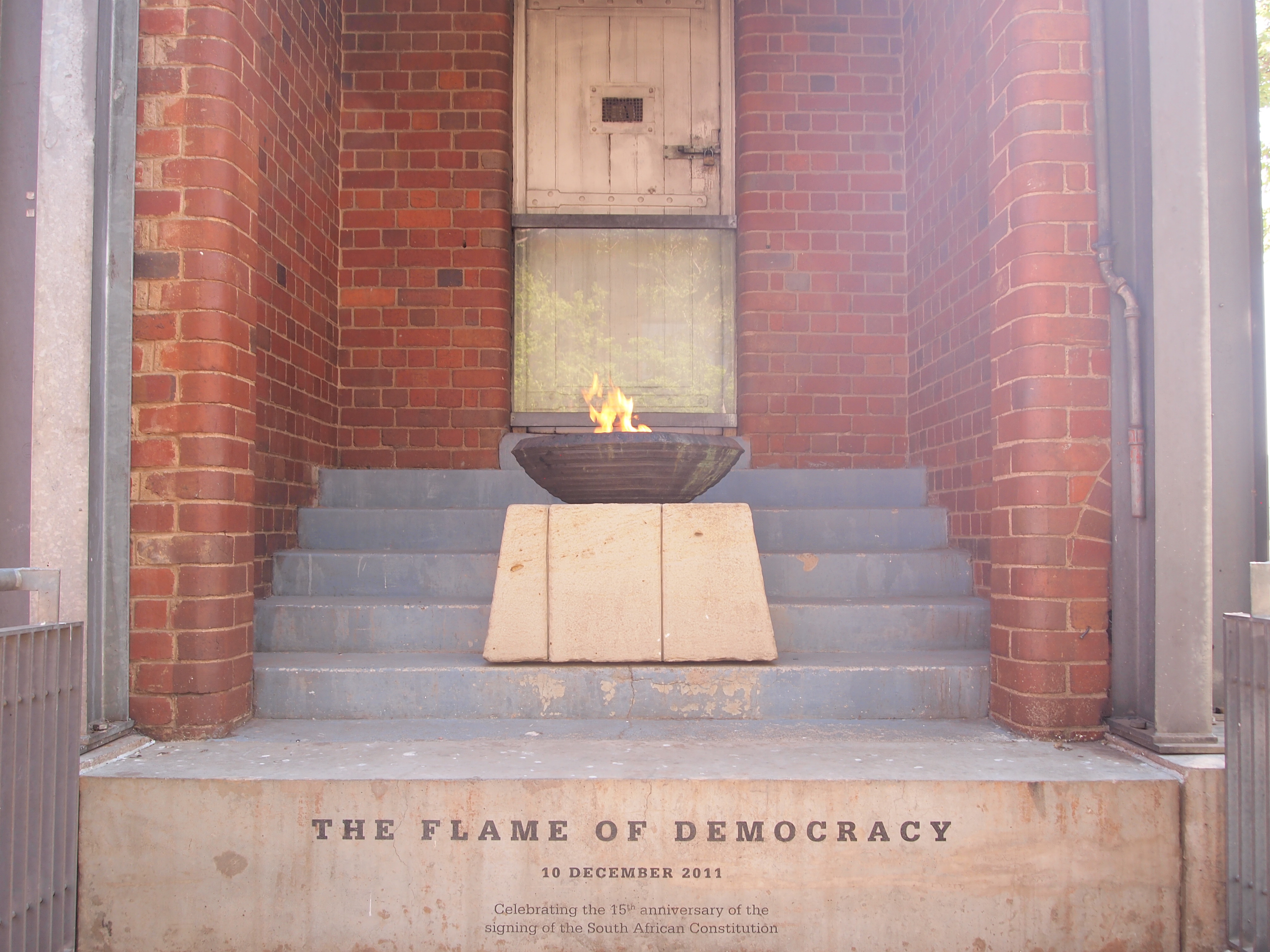
The eternal flame on Constitution Hill in Johannesburg — CC BY 4

The Johannesburg skyline, by Khaanya96 — CC BY-SA 4

Hillbrow Tower, Johannesburg, by Thuvack — CC BY-SA 3
History of Constitution Hill
The history of Constitution Hill begins in eighteen ninety-three, when the South African Republic built a prison in the newly founded town, and when the fort was built on the hill, and when the prison grew, under British rule after the Anglo-Boer War, and under the Union of South Africa, and under the apartheid government. The Old Fort was built from eighteen ninety-three, and it was first a prison for all male prisoners, but under the Union and under apartheid, it mainly held white prisoners, while Number Four was built for black men, and the Women’s Jail, built in nineteen ten, held women of every racial classification. The prison was a place of thousands of people, with terrible living conditions, and it became the symbol of oppression under apartheid, with the cells, and with the isolation cells, and with the stories of the people who were held there, and with the hill as the place that cut them off from the city.
Mahatma Gandhi was held in the Old Fort in nineteen hundred and six, for refusing to register under the Asiatic Registration Act, and again in nineteen thirteen, and he was one of the most famous prisoners of the fort, and one of the men whose time in the prison shaped his thinking. Nelson Mandela was held in the Awaiting Trial Block in the nineteen fifties, before he was held on Robben Island, and he was one of the most famous prisoners of the hill, and one of the leaders whose imprisonment became the symbol of the struggle. The prison held thousands of others, whose names are not known, and whose stories are told by the guides, and by the exhibitions, and by the cells themselves, with the walls, and with the small windows, and with the conditions that the prisoners endured. The history of the hill is the history of those prisoners, and of the system that held them, and of the resistance that they were part of.
The prison finally closed in nineteen eighty-three, and after apartheid was abolished and the transition to democracy began, the new Constitutional Court looked for a home from nineteen ninety-six, and found it on the hill. The choice was deliberate: the Constitution that ended apartheid would stand on the land where apartheid had held those who opposed it, and the court would be built on the site of the prison, with the bricks of the demolished Awaiting Trial Block used in the new building. Most of the Awaiting Trial Block was demolished to make room for the court, and only four stairwells were kept in part, with two forming large symbolic columns, one integrated into the court, and one standing just behind the building. The court was designed by OMM Design Workshop and Urban Solutions, who won the design competition in nineteen ninety-eight, and it was designed deliberately not to be grand, so that it would feel approachable, and so that it would be a court for the people, not a fortress.
The Constitutional Court was inaugurated on the twenty-first of March two thousand and four, Human Rights Day, and ten years after South Africa became a democracy, with President Thabo Mbeki speaking at the ceremony, and the next day, the twenty-second of March two thousand and four, Constitution Hill opened to the public as a museum of heritage, of education, and of tourism. The court is the highest court of South Africa, and it hears the cases on the Constitution, with the judgements that have changed the country since the court first sat in nineteen ninety-five. The building covers eight thousand one hundred and seventy-eight square metres on three floors, and it is a modern building, with the materials of the old prison, and with the light, and with the openness that the architects wanted, in contrast to the darkness of the cells. The court is the end of the prison, and the beginning of the law, on the same hill.
In two thousand and twenty-four, Constitution Hill became a component of the World Heritage site Human Rights, Liberation and Reconciliation: Nelson Mandela Legacy Sites, ref one six seven six, inscribed in two thousand and twenty-four, criteria (vi), with an area of five point three four hectares, and with fourteen components across South Africa. The inscription recognised the sites of the liberation struggle, and Constitution Hill was inscribed as component one six seven six dash zero zero nine, for its role as the prison that held the leaders, and as the court that now protects the rights they fought for. The inscription brought international attention to the complex, and strengthened the programmes of conservation and of education there, and it made the hill one of the most important heritage sites in South Africa. The hill, which had been a prison, and then a court, became a World Heritage site, and the three layers, prison, court, and heritage, are the history of the place, on a single hill, in a single city.

Mahatma Gandhi in South Africa in 1906 — Public domain

Nelson Mandela in 1962, by Michael Peto — Public domain
Travel to Constitution Hill
Travellers to Constitution Hill should take a guided tour, because the guides tell the story of each area, and of the people who were held there, and because the complex has many areas, from the Old Fort to the Constitutional Court, and needs time to see. The tour usually starts at the Old Fort, then goes to Number Four and to the Women’s Jail, and ends at the Constitutional Court, with the guide explaining the history of each area and the change from a prison to a court. Travellers should allow at least two to three hours at the complex, because there is much to see and many stories to hear, and because the content is heavy, and because the visit is best taken slowly, with time to rest after the prison sections, and with water to drink. The morning is the best time to visit, when the complex is less crowded than in the afternoon, and tours should be booked ahead, because they are often full at the weekend.
The Constitutional Court is a modern building, designed by OMM Design Workshop and Urban Solutions, who won the design competition in nineteen ninety-eight, and it is an important work of architecture in South Africa. The building was designed deliberately not to be grand, so that it would feel approachable, and it combines the materials of the demolished prison, with the bricks of the old buildings used in the new building, so that the prison is literally part of the court. Travellers can visit the court when it is not sitting, and should check the court calendar before going, because the building can be closed when there is an important hearing. The architecture is the story of the change, from the fortress of the prison to the openness of the court, and the building is the place where that change can be seen, in the light, and in the materials, and in the space.
Travellers should combine a visit to Constitution Hill with a visit to the Apartheid Museum in the south of Johannesburg, because both places tell the story of apartheid and of the struggle for human rights, and both are in the same city. The Apartheid Museum, in Ormonde, about eight kilometres south of the centre, opened on the thirtieth of November two thousand and one, and has twenty-one exhibitions telling the story of apartheid from nineteen forty-eight to nineteen ninety-four, and it is the leading museum in the world on the period. The two places together give the full story: the museum gives the history of the system, and the hill gives the history of the people who were held by it, and of the court that replaced it. A day that takes in both is a day of history, and it is the day that most visitors to Johannesburg should plan, with the morning at the hill and the afternoon at the museum, or the other way around.
Travellers should prepare themselves before visiting Constitution Hill, because the content is emotionally strong, especially the exhibitions on the prison, with the cramped cells and with the stories of the people who were held there. Travellers should carry drinking water, and should plan to rest after visiting the complex, because the visit is long and the content is heavy, and because the hill is a place of memory, not of entertainment. The complex is in the inner city, and it can be reached by car or by bus from the centre, and travellers should be careful about security in the evening, and should plan to leave before dark. The visit is worth the effort, because the hill is one of the most important places in South Africa, and because the story it tells, from prison to court, is the story of the country itself.
Travellers planning a wider trip can follow South Africa tours after the visit.

A detail of the Womens Gaol on Constitution Hill in Johannesburg — CC BY-SA 4

The entrance of the Apartheid Museum, Johannesburg, by Annette Kurylo — CC BY-SA 3
Notable Places in Constitution Hill
The Old Fort — The Oldest Prison on the Hill
The Old Fort is the oldest prison on Constitution Hill, built from eighteen ninety-three, and it was first a prison for all male prisoners, but under the Union and under apartheid, it mainly held white prisoners, with the cells and the isolation cells that held the men who were punished most. The fort was built by the South African Republic, and its soldiers patrolled the walls during the Anglo-Boer War, from eighteen ninety-nine to nineteen hundred and two, until the British entered the city in nineteen hundred and took over the fort. The fort has the isolation cells, with the narrow space and the terrible conditions, and it is where Mahatma Gandhi was held in nineteen hundred and six and in nineteen thirteen, for refusing to register under the Asiatic Registration Act. The Old Fort is one of the best preserved areas of the complex, and it is the place where the oppression of apartheid can be seen most clearly, in the cells, and in the walls, and in the stories of the men who were held there.
A visit to the Old Fort is a visit to the isolation cells, with the narrow space, and with the darkness, and with the guide telling the story of each cell and of the men who were held in it. The fort is the oldest part of the hill, and it is the part that shows the prison at its earliest, with the walls, and with the cells, and with the history of the fort as a military post, and then as a prison. The Old Fort is the beginning of the tour, and it is the place where the traveller learns what the hill was, before it became a court, and before it became a museum, and before it became a World Heritage site.

The Old Fort at Constitution Hill during the Boer War, looking toward Jeppestown, by Rijksmuseum — CC0
Number Four and the Women’s Jail — The Prisons of Apartheid
Number Four is the prison for black men, built in the nineteen thirties and forties, and it is the most notorious prison on Constitution Hill, with overcrowded cells, and with poor sanitation, and with the brutal treatment that made it the symbol of the racial prison system. Number Four held thousands of men, with the cells cramped and dirty, and with the prisoners treated as less than human, and the guides tell the stories of the men who were held there, and of the conditions that they endured, and of the resistance that they kept alive. The Women’s Jail, built in nineteen ten, held women of every racial classification, with the same poor conditions, and with the women who had been arrested for their part in the resistance, and the guides tell the stories of the women, and of their part in the struggle against apartheid. The two prisons together are the apartheid prison, and they are the places where the system can be seen at its worst, in the cells, and in the walls, and in the stories.
A visit to Number Four and to the Women’s Jail is a visit to the cells, with the walls, and with the small windows, and with the guide explaining the history of each area, and the stories of the people who were held there. Travellers should spend time in both areas, because each tells a different part of the story, and because the narration gives the context and the personal stories that the objects alone cannot tell. The two prisons are the heart of the hill, and they are the places where the traveller understands what apartheid meant, in the daily life of the prisoners, and in the conditions that they lived in, and in the resistance that they kept.

The Women’s Jail at Constitution Hill, Johannesburg, by Islahaddow — CC BY-SA 4
The Constitutional Court — The Building That Replaced the Prison
The Constitutional Court is the modern building on the hill, inaugurated on the twenty-first of March two thousand and four, and it is the home of the highest court of South Africa, where the cases on the Constitution are heard. The building was designed by OMM Design Workshop and Urban Solutions, who won the design competition in nineteen ninety-eight, and it covers eight thousand one hundred and seventy-eight square metres on three floors, and it is an important work of architecture in South Africa. The building was designed deliberately not to be grand, so that it would feel approachable, and it combines the materials of the demolished prison, with the bricks of the old buildings used in the new building, so that the prison is literally part of the court. The court is the symbol of reconciliation, and of the new South Africa, and it is the place where the change of the country can be seen most clearly, from the prison to the court, and from the violation of rights to their protection.
A visit to the court is a visit to the architecture, with the light, and with the materials, and with the space, and with the guide explaining how the building was made, and how the prison was used in it, and how the court works. Travellers can visit the court when it is not sitting, and should check the calendar before going, because the building can be closed for an important hearing, and the visit is best combined with the tour of the prisons, so that the change from one to the other can be seen in a single visit. The court is the end of the tour, and it is the place where the hill shows its new face, with the law, and with the light, and with the openness that the architects wanted.

The entrance of the Constitutional Court of South Africa, by André-Pierre — CC BY 2
The Apartheid Museum and Robben Island — The Companion Sites
The Apartheid Museum is the leading museum in the world on apartheid, in Ormonde, in the south of Johannesburg, about eight kilometres from the centre, and it is the place that visitors to Constitution Hill should combine with the hill. The museum opened on the thirtieth of November two thousand and one, and it has twenty-one exhibitions telling the story of apartheid from nineteen forty-eight to nineteen ninety-four, with the documents, with the photographs, and with the voices of the witnesses, and it is the museum that gives the history of the system. Robben Island, off Cape Town, is the third of the companion sites, where Nelson Mandela was held for eighteen years, and where the prison of the island is the other great prison of apartheid, with the cell that Mandela lived in, and with the guides who were themselves prisoners there. The three places together, Constitution Hill, the Apartheid Museum, and Robben Island, tell the story of apartheid and of the struggle for human rights, and they are the three places that a visitor to South Africa should see, to understand the country.
A visit to the companion sites is a visit over several days, because the museum is in Johannesburg, and Robben Island is in Cape Town, about one thousand two hundred and fifty-two kilometres away, and the three together need a journey across the country. The museum is the place to go after the hill, in the same day, with the morning at the hill and the afternoon at the museum, while Robben Island is the place to go on a later day, in Cape Town, with the ferry to the island, and with the tour of the prison. The three sites are the story of South Africa, and they are the places where the history of the country can be seen, from the prison to the court, and from the museum to the island, and from the past to the present.
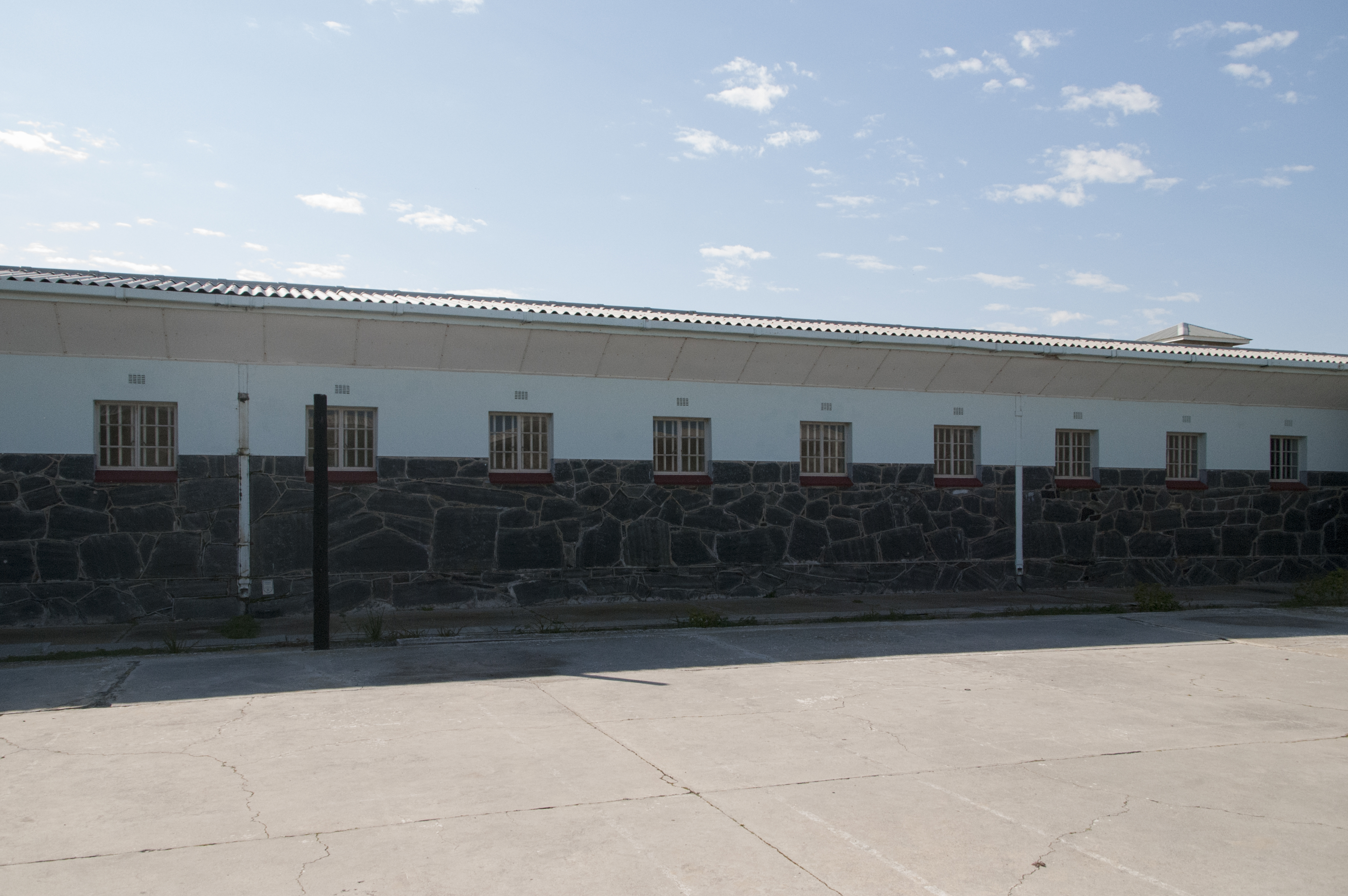
The maximum security prison on Robben Island, by Moheen Reeyad — CC BY-SA 4
Frequently Asked Questions
Where is Constitution Hill?
Constitution Hill stands on a hill in Braamfontein and Hillbrow, in inner-city Johannesburg, close to the centre.
What is Constitution Hill?
Constitution Hill is a historic complex in Johannesburg, once the most notorious prison in South Africa, now home to the Constitutional Court.
Who was held at Constitution Hill?
Gandhi was held in the Old Fort in nineteen hundred and six and nineteen thirteen, and Mandela in the Awaiting Trial Block.
When was the Constitutional Court inaugurated?
The Constitutional Court was inaugurated on the twenty-first of March two thousand and four, Human Rights Day.
Is Constitution Hill a UNESCO World Heritage site?
Yes, Constitution Hill is component one six seven six dash zero zero nine of the Mandela Legacy Sites, inscribed in two thousand and twenty-four.
What should I combine Constitution Hill with?
Combine Constitution Hill with the Apartheid Museum in the south of Johannesburg, which tells the story of apartheid from nineteen forty-eight to nineteen ninety-four.
Verified
- Constitution Hill stands on a hill in Braamfontein and Hillbrow, Johannesburg, at about 26.1886° S and 28.0428° E, per Wikidata Q5164101, checked 24/11/2026.
- The Old Fort was built from 1893, Number Four in the 1930s and 1940s, and the Women’s Jail in 1910, and the prison closed in 1983, checked 24/11/2026.
- Mahatma Gandhi was held in the Old Fort in 1906 and 1913, and Nelson Mandela was held in the Awaiting Trial Block in the 1950s, checked 24/11/2026.
- The Constitutional Court was inaugurated on 21 March 2004, and Constitution Hill opened to the public on 22 March 2004, checked 24/11/2026.
- Constitution Hill is component 1676-009 of the Human Rights, Liberation and Reconciliation: Nelson Mandela Legacy Sites, ref 1676, inscribed in 2024, criteria (vi), area 5.34 ha, checked 24/11/2026.
- The court was designed by OMM Design Workshop and Urban Solutions, who won the design competition in 1998, and the building covers 8,178 m² on three floors, checked 24/11/2026.
- The Apartheid Museum opened on 30 November 2001, and has 21 exhibitions, checked 24/11/2026.
- The Constitutional Court first sat in 1995, checked 24/11/2026.
- This entity is an L4 place with registry volume_max 10 (DE), primary keyword “constitution hill johannesburg deutsch”, and the focus of this article is Constitution Hill, checked 24/11/2026.
Sources
- Constitution Hill — official site (https://www.constitutionhill.org.za/) — checked 24/11/2026.
- Nelson Mandela Legacy Sites — UNESCO (https://whc.unesco.org/en/list/1676/) — checked 24/11/2026.
- Mandela Legacy Sites maps — UNESCO (https://whc.unesco.org/en/list/1676/maps/) — checked 24/11/2026.
- Constitution Hill, Johannesburg — Wikipedia (https://en.wikipedia.org/wiki/Constitution_Hill,_Johannesburg) — checked 24/11/2026.
- Constitution Hill — Wikidata Q5164101 (https://www.wikidata.org/wiki/Q5164101) — checked 24/11/2026.
Unverified
- The registry Q-ID Q138650305 is a street in Dublin, Ireland, at about fifty-three point three degrees north and six point two degrees west, and is NOT Constitution Hill in Johannesburg; the correct Q-ID is Q5164101, checked 24/11/2026.
- The registry coordinates belong to the street in Dublin, not to Constitution Hill in Johannesburg; the correct coordinates are about twenty-six point one degrees south and twenty-eight point zero degrees east, checked 24/11/2026.
- The registry unesco flag is wrong: Constitution Hill IS component 1676-009 of the Mandela Legacy Sites, ref 1676, inscribed in 2024, checked 24/11/2026.
- The opening hours and the ticket prices of Constitution Hill change with the season and with events, and this article gives no hours or prices, because they were not verified on the official site of the complex, checked 24/11/2026.
Illustrations
- Hero: View of Constitution Hill. Free image: https://upload.wikimedia.org/wikipedia/commons/a/ad/Constitution_Square_at_Constitution_Hill.jpg — CC BY-SA 3.
- In body, Constitution Hill: The eternal flame on Constitution Hill in Johannesburg. Free image: https://upload.wikimedia.org/wikipedia/commons/d/db/Eternal_Flame_on_Constitution_Hill_in_Johannesburg.JPG — CC BY 4.
- In body, Womens Gaol: A detail of the Womens Gaol on Constitution Hill in Johannesburg. Free image: https://upload.wikimedia.org/wikipedia/commons/8/88/Womens_Gaol%2C_Constitution_Hill%2C_Johannesburg_2.jpg — CC BY-SA 4.
- In body, Johannesburg skyline: The Johannesburg skyline, by Khaanya96. Free image: https://upload.wikimedia.org/wikipedia/commons/c/c6/Johannesburg_skyline.jpg — CC BY-SA 4.
- In body, Hillbrow Tower: Hillbrow Tower, Johannesburg, by Thuvack. Free image: https://upload.wikimedia.org/wikipedia/commons/4/4a/Hillbrow_Tower-1.jpg — CC BY-SA 3.
- In body, Mahatma Gandhi: Mahatma Gandhi in South Africa in 1906. Free image: https://upload.wikimedia.org/wikipedia/commons/d/d5/Mohandas_K._Gandhi_in_South_Africa%2C_1906.jpg — Public domain.
- In body, Nelson Mandela: Nelson Mandela in 1962, by Michael Peto. Free image: https://upload.wikimedia.org/wikipedia/commons/a/ae/Nelson_Mandela_in_Haringey_%28June_1962%29.jpg — Public domain.
- In body, Apartheid Museum: The entrance of the Apartheid Museum, Johannesburg, by Annette Kurylo. Free image: https://upload.wikimedia.org/wikipedia/commons/4/4b/Apartheid_Museum_Entrance%2C_Johannesburg.JPG — CC BY-SA 3.
- In body, Old Fort: The Old Fort at Constitution Hill during the Boer War, looking toward Jeppestown, by Rijksmuseum. Free image: https://upload.wikimedia.org/wikipedia/commons/3/30/Uitkijkpunt_met_een_oud_Boerenkanon%2C_gezien_vanaf_Constitution_Hill_Looking_from_Johannesburg_Fort_toward_Jeppertown_%28showing_old_Boer_Gun%29%2C_Boer_War%2C_South_Africa_%28titel_op_object%29%2C_RP-F-F09008.jpg — CC0.
- In body, Women’s Jail: The Women’s Jail at Constitution Hill, Johannesburg, by Islahaddow. Free image: https://upload.wikimedia.org/wikipedia/commons/b/be/Womens_Gaol%2C_Constitution_Hill%2C_Johannesburg_10.jpg — CC BY-SA 4.
- In body, Constitutional Court: The entrance of the Constitutional Court of South Africa, by André-Pierre. Free image: https://upload.wikimedia.org/wikipedia/commons/d/de/ConstitutionalCourtofSouthAfrica-entrance-20070622.jpg — CC BY 2.
- In body, Robben Island: The maximum security prison on Robben Island, by Moheen Reeyad. Free image: https://upload.wikimedia.org/wikipedia/commons/0/08/B-Section%2C_Maximum_Security_Prison%2C_Robben_Island_%2801%29.jpg — CC BY-SA 4.