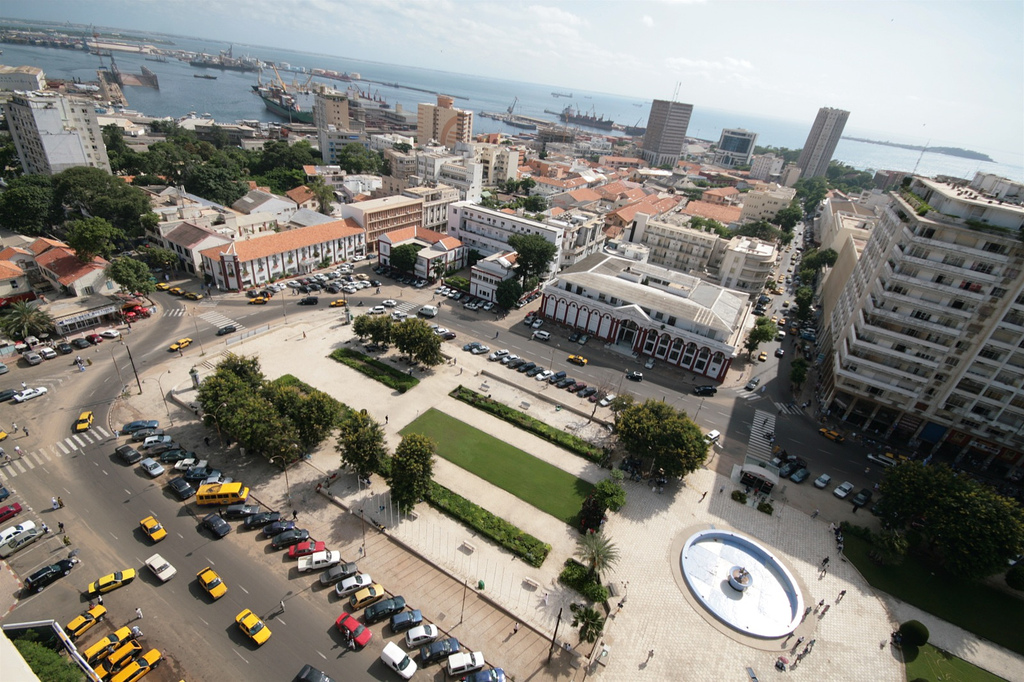
Dakar
Dakar is the capital of Senegal, a city on the Cap-Vert peninsula at the western edge of Africa. Its markets, music, and Gorée fill two to four days.
Dakar is the capital and the largest city of Senegal, set on the Cap-Vert peninsula, a volcanic headland that juts into the Atlantic and forms the westernmost point of the African mainland. The city holds about 1,280,000 people in its own department and about four million across the wider region, and it serves as the political, economic, and cultural centre of Senegal. Dakar mixes a colonial port, a fishing coast, and a young creative scene: the island of Gorée offshore, the African Renaissance Monument on the hills, the markets of Sandaga, and the mbalax music that fills the night. Travellers come for history and for the sea, and Dakar travel rewards two to four unhurried days.
Quick Facts
- Name: Dakar, called Ndakaaru in Wolof
- Place: Capital and largest city of Senegal, on the Cap-Vert peninsula, the westernmost point of mainland Africa
- People: About 1,280,000 in the Dakar department and about four million across the Dakar region, in the 2023 census
- Coordinates: 14 degrees 40 minutes north, 17 degrees 26 minutes west
- Famous for: Gorée Island, the African Renaissance Monument, the Museum of Black Civilizations, and the beaches of the Corniche
- Highlights: The Island of Gorée and the House of Slaves, the African Renaissance Monument, Lac Rose, Sandaga market, the Museum of Black Civilizations
- Best season: The dry season from November to May, when the sun shines, the wind blows cool, and the humidity stays low
- Getting there: Blaise Diagne International Airport at Diass, about 47 kilometres east, linked by the TER train
- Dakar travel: Best in the dry season, from November to May, when the wind blows cool and the humidity stays low
Geography of Dakar
Dakar stands on the Cap-Vert peninsula, a volcanic headland that pushes into the Atlantic Ocean and forms the westernmost point of the African mainland, with one of the finest natural harbours of West Africa. The city spreads across the narrow peninsula, with a northern shore facing the open Atlantic and a southern shore facing the Bay of Dakar, where the port and the old town stand.
The land is fairly flat, with a few low hills, the best known being the twin hills of Les Mamelles, which hold the African Renaissance Monument and an old lighthouse. The position of the city on the world map makes it a major air and sea gateway of West Africa, with flights to Europe, the Americas, and across Africa. Dakar travel starts at the port, where ferries leave for Gorée and fishing boats crowd the harbour.
The climate of the city is dry and tropical, with two clear seasons: a dry season from November to May and a rainy season from June to October. The dry season is cool and pleasant, with average temperatures around 24 to 26 degrees Celsius, and the harmattan wind from the Sahara brings dry air and sometimes dust.
The rainy season brings short, heavy showers, with temperatures rising to about 28 to 30 degrees and high humidity, though the rain rarely lasts all day. Annual rainfall is about 500 millimetres, far lower than in other coastal cities of West Africa, because the city sits on the edge of the dry Sahel. Dakar travel is easiest in the dry season, when the harmattan wind keeps the air clear and the humidity stays low.
The urban area of the city is the most crowded part of Senegal, with about four million people in the Dakar region, close to a quarter of the whole country, in the 2023 census. The old city of Dakar, the department itself, holds about 1,280,000 people, while suburbs such as Pikine, Guédiawaye, and Rufisque have grown fast and merged with the centre. Rapid growth has put pressure on housing, transport, and public services, and the government of Senegal has built the new city of Diamniadio, about 30 kilometres away, to ease the load on the capital. Diamniadio holds government offices, universities, and new industrial zones, and it links to Dakar by motorway and train.
The sea is inseparable from the geography of Dakar, with a long coast, beaches such as Yoff, Ngor, and Almadies, and traditional fishing villages that work every day. Fishermen of Dakar put out to sea early in the morning in brightly painted pirogues, and return in the afternoon with fresh fish for the coastal markets. Ngor Island, a small island near the coast, is a popular weekend escape for local people, with beaches, restaurants, and a quieter mood than the centre. The Madeleine Islands, about four kilometres west of Dakar, form a marine reserve with basalt cliffs and many seabirds.
Dakar is the transport hub of Senegal, with the largest port in the country, Blaise Diagne International Airport, and a train station linking the city with other regions. Blaise Diagne Airport opened in 2017, replacing the old Léopold Sédar Senghor Airport in the centre of Dakar, and it stands at Diass, about 47 kilometres east of the city. The TER train links the airport with Dakar and Diamniadio, letting travellers move fast and avoid traffic. Inside the city, visitors travel by bus, taxi, and car rapide, the small colourful buses that have become a symbol of Dakar transport.

Mermoz Bay in Dakar, Senegal — CC0
History of Dakar
The history of the city begins with the Lebou fishing villages on the Cap-Vert peninsula, whose people lived there for centuries before the Europeans arrived. The Portuguese were the first Europeans to reach the area in the fifteenth century, and they called the peninsula Cabo Verde, or Green Cape, for the green plants seen from the sea. The Island of Gorée, three and a half kilometres off the coast of Dakar, became an important trading post, where Europeans exchanged goods with Africans, and later a centre of the transatlantic slave trade. Gorée was inscribed by UNESCO in 1978 as ref 26, with criterion six, as a testimony to one of the greatest tragedies in human history, and the island is a separate property, not a part of the city of Dakar.
The French founded Dakar in 1857, when they built a fort and a port on the Cap-Vert peninsula, and the city quickly grew into the administrative and trading centre of French West Africa. In 1902 Dakar became the capital of the Federation of French West Africa, replacing Saint-Louis, and the city was laid out with wide avenues, government buildings, and a European quarter. The port of Dakar became one of the most important in Africa, where ships from Europe to South America stopped to refuel and load cargo. The population of the city grew fast in the colonial period, with people from across Senegal and West Africa coming to find work.
After Senegal won independence in 1960, Dakar became the capital of the Republic of Senegal, and the home of President Léopold Sédar Senghor, the poet and statesman who led the country for its first twenty years. Dakar travel grew with independence, as the city built hotels, museums, and a new airport for visitors from Europe and America. Under Senghor, Dakar became a cultural centre of Africa, hosting the World Festival of Black Arts in 1966, which drew artists, writers, and musicians from around the world.
The city also hosts the headquarters of the Central Bank of West African States and many international bodies, which fixed its standing as a financial and diplomatic centre of the region. New quarters such as Plateau, Medina, and Grand Dakar grew fast, and the city spread into the suburbs.
Recent decades have brought large changes to Dakar, with the building of the African Renaissance Monument in 2010, the Museum of Black Civilizations in 2018, and the new city of Diamniadio. The African Renaissance Monument, 52 metres high, is the tallest statue in Africa, and it stands on the Les Mamelles hills, looking out over the Atlantic. The Museum of Black Civilizations is one of the largest museums in Africa, with more than 14,000 square metres of galleries on the history, art, and culture of Africans and the African diaspora. Dakar also gave its name to the Paris-Dakar rally, which ran from 1979 to 2007 and carried the name of the capital around the world.
Dakar today is a young, lively, and creative city, with most of its people under twenty-five, a vibrant mbalax music scene, and a growing community of artists, designers, and entrepreneurs. The city faces real challenges, such as traffic, a shortage of housing, and pollution, but it also holds many opportunities, with large infrastructure projects and a growing economy. Dakar keeps its role as the political, economic, and cultural centre of Senegal, and as one of the most important cities of West Africa, where the colonial past, the history of the slave trade, and a modern African future meet. Dakar travel now draws visitors for the music festivals, the beaches, and the art scene, as well as for the history of Gorée.

Gianni Lora Lamia Mitsubishi Ralliart 24th Arras Madrid Dakar 2002 Podium Dakar Senegal — CC0
Travel to Dakar
Dakar travel offers a different experience from many African capitals, because the city combines history, culture, music, and the sea in a small and easy space. On a Dakar travel trip, travellers usually stay two to four days, enough to visit Gorée, the African Renaissance Monument, the museums and markets, and to spend an afternoon on the beach at Ngor or Yoff. The city offers many places to stay, from international hotels in the Plateau quarter to small guesthouses and rented flats in Almadies and Ngor, where many seafront restaurants and bars stand. Dakar travel costs sit at a middle level for West Africa, with cheap local restaurants and high-end hotels priced like those in Europe.
The Island of Gorée is the most important sight for Dakar travel, and travellers should give it at least half a day. The ferry from the port of Dakar to Gorée runs often during the day, the crossing takes about twenty minutes, and the island has no cars, only footpaths between colourful houses. The House of Slaves, with its famous Door of No Return, is a solemn memorial, and travellers should take time to listen to the guide tell the history of the slave trade. Gorée also holds small museums, a church, a mosque, and craft shops, and it offers a fine view of Dakar from its shore.
Music and food are two reasons Dakar travel wins visitors, with mbalax music sounding across the city, from bars in Almadies to street performances in Medina. Travellers should try thiéboudiène, the national fish and rice dish of Senegal, mafé, a meat stew in peanut sauce, and yassa, chicken or fish with onions and lemon. Sandaga market and Kermel market are the best places to buy cloth, crafts, and spices, though visitors should bargain and watch their belongings in the crowds. Evenings on a Dakar travel trip are lively, with live music clubs, seafront restaurants, and cafes in the Plateau quarter.
Dakar travel also makes an ideal base for short trips to other places in Senegal, and most Senegal tours start here before covering Lac Rose, Saint-Louis, Saly, and the Djoudj bird sanctuary. Lac Rose, about 30 kilometres north of Dakar, is famous for its pink water, coloured by the algae Dunaliella salina, and for traditional salt harvesting.
Saint-Louis, the former capital of French West Africa, lies about 270 kilometres north by road, an old city with colonial architecture and the famous Faidherbe bridge. For Dakar travel beyond the city, travellers can hire a car or join a day tour to Lac Rose, and give two days to Saint-Louis and the Djoudj sanctuary, one of the most important bird reserves of West Africa. From Dakar, travellers can also fly to Accra in Ghana or Lagos in Nigeria for a longer West African trip.
Notable Places in Dakar
Island of Gorée and the House of Slaves
The Island of Gorée, three and a half kilometres off the coast of Dakar, is the first stop of most Dakar travel, covers 28 hectares, and was inscribed by UNESCO in 1978 as ref 26, with criterion six, as a testimony to the transatlantic slave trade. The House of Slaves, built late in the eighteenth century, held enslaved people before they were shipped to the Americas, and its Door of No Return has become a symbol of that tragedy. Gorée also holds a fort, a church, a mosque, and colourful colonial houses, and it draws pilgrims from the African diaspora.
African Renaissance Monument
The African Renaissance Monument, a landmark of Dakar travel, stands 52 metres high on the Les Mamelles hills in the west of Dakar, and it is the tallest statue in Africa, unveiled in 2010. The monument shows a man, a woman, and a child stepping out of a volcano, a symbol of rebirth and the future of Africa. Visitors can ride a lift inside the statue to a viewing platform in the head of the man, with a sweeping view of Dakar and the Atlantic.
Lac Rose
Lac Rose lies about 30 kilometres north of Dakar, near a fishing village, and it is famous for its pink water, coloured by the algae Dunaliella salina living in the salty water. The pink colour changes with the time of day and the season, and it shows strongest in the dry season, when the water evaporates and the salt grows more concentrated. Local people harvest salt from the lake by hand, and visitors can watch them work, swim in the salty water, and ride camels on the dunes around the lake.
Sandaga market and Kermel market
Sandaga market is the largest and busiest market of Dakar, in the centre of the city, with thousands of stalls selling cloth, clothing, electronics, spices, and crafts. The market shows the trading life of Dakar, with calls from sellers, the smell of spices, and the colours of wax-print cloth. Kermel market, nearby, is smaller and quieter, with colonial architecture and stalls selling flowers, fruit, and crafts, and it suits travellers who want souvenirs without the crush of Sandaga.
Museum of Black Civilizations
The Museum of Black Civilizations, a quiet stop on a Dakar travel itinerary, opened in 2018 and ranks among the largest museums in Africa, with more than 14,000 square metres of galleries on the history, art, and culture of Africans and the African diaspora. The museum holds rooms on African history, contemporary art, religion, and science, with objects from across the continent. The round building takes its shape from traditional African architecture, and it stands in the Plateau quarter near the centre of Dakar.
Ngor Island and the Madeleine Islands
Take the pirogue from Ngor beach in the morning, when the sea is calm, and the crossing to Ngor Island takes only a few minutes. The island has no cars, so visitors walk everywhere, swim at the small beach, and eat grilled fish at the restaurants by the water. From the Corniche, boats run to the Madeleine Islands, a marine reserve of basalt cliffs and seabird colonies, where the guide points out the nesting cliffs.
Frequently Asked Questions
What is there to see in Dakar and how many days should I stay?
Dakar travel covers the Island of Gorée, the African Renaissance Monument, Lac Rose, Sandaga market, the Museum of Black Civilizations, and the beaches of Ngor and Yoff. Travellers should stay two to four days, enough to visit Gorée in half a day, tour the city centre in a day, and give a day to Lac Rose or Saint-Louis. The city is compact and easy to explore, with most sights within a few kilometres of the centre.
How do I get from Dakar to the Island of Gorée?
Boats leave the port of Dakar for Gorée through the morning, and the ride takes about twenty minutes across the bay. Buy the ticket at the harbour office, not from touts on the quay, and keep it for the return, because the same ticket covers the trip back. Once on the island, walk the lanes without a plan first, then visit the Maison des Esclaves and the small museums before the last boat of the afternoon.
Is Dakar safe for travellers?
Dakar is easy for visitors, and the only real worry is a snatched bag at Sandaga market or on a crowded bus, so keep valuables in a front pocket and the camera strap around the neck. After dark, ride in a taxi booked by the hotel, and agree the fare before the car moves. The hotel safe is the best place for the passport, and a photocopy is enough for the day.
When is the best time to visit Dakar?
The best time for Dakar travel is the dry season from November to May, when the sun shines, the wind blows cool, the humidity stays low, and temperatures sit around 24 to 26 degrees Celsius. The rainy season from June to October brings showers and high humidity, but travel is still possible, with lower hotel prices. Travellers who want to see birds at the Djoudj sanctuary should come from November to April, when migrant birds arrive from Europe.
What should I eat in Dakar?
Travellers should taste thiéboudiène, the national fish and rice dish of Senegal, mafé, a meat stew in peanut sauce, and yassa, chicken or fish with onions and lemon. Restaurants in Almadies and Ngor serve fresh seafood, with fish, prawns, and octopus caught the same day. Travellers should also try bissap, juice from the hibiscus flower, and café Touba, the spiced coffee of Senegal, sold at street cafes across the city.
How do I get from Blaise Diagne Airport to central Dakar?
Dakar travel starts at Blaise Diagne International Airport, at Diass, about 47 kilometres from Dakar, and travellers can take the TER train, a bus, or a taxi into the city centre. The TER train is the fastest and cheapest way, with a journey of about forty-five minutes to Dakar station, while a taxi takes about an hour depending on traffic. Travellers should avoid unofficial taxis at the airport and agree on the fare before the ride if they do not take the train.
Verified
- Dakar travel begins in the capital of Senegal, on the Cap-Vert peninsula, the westernmost point of mainland Africa, with coordinates 14 degrees 40 minutes north and 17 degrees 26 minutes west — checked 23 November 2026
- The Dakar region holds about four million people and the Dakar department about 1.28 million, in the 2023 census of Senegal — checked 23 November 2026
- The Island of Gorée lies three and a half kilometres off the coast of Dakar, covers 28 hectares, and was inscribed by UNESCO in 1978 as ref 26 with criterion six — checked 23 November 2026
- Dakar was founded by the French in 1857, became the capital of French West Africa in 1902, and became the capital of independent Senegal in 1960 — checked 23 November 2026
- The African Renaissance Monument stands 52 metres high and was unveiled in 2010, and the Museum of Black Civilizations opened in 2018 — checked 23 November 2026
- Blaise Diagne International Airport opened in 2017, replacing Léopold Sédar Senghor Airport, and stands at Diass about 47 kilometres from Dakar — checked 23 November 2026
Sources
- Island of Gorée — UNESCO (https://whc.unesco.org/en/list/26/) — inscribed 1978, ref 26, criterion six, 28 hectares, three and a half kilometres off Dakar — checked 23 November 2026
- Dakar — Wikipedia (https://en.wikipedia.org/wiki/Dakar) — founded 1857, African Renaissance Monument, Blaise Diagne Airport — checked 23 November 2026
- CityPopulation — Dakar (https://www.citypopulation.de/en/senegal/admin/SN01__dakar/) — 2023 census, Dakar region 4,004,427 people — checked 23 November 2026
- Wikidata Q3718 — Dakar (https://www.wikidata.org/wiki/Q3718) — capital of Senegal, coordinates match the registry — checked 23 November 2026
Unverified
- Current ferry fares from Dakar to Gorée change from year to year and were not checked on the official site of the ferry operator.
- Entry fees for the Museum of Black Civilizations and the African Renaissance Monument were not checked directly on the official sites of the sights.
- The detailed timetable of the TER train from Blaise Diagne Airport to Dakar changes by season and was not checked on the official site of the operator.
- The exact number of visitors to Dakar each year was not checked against Senegalese tourism statistics.
Illustrations
- Hero: View of Dakar. Free image: https://upload.wikimedia.org/wikipedia/commons/4/46/Dakar-Ind%C3%A9pendance.jpg — CC BY 2.
- In body, Dakar: Mermoz Bay in Dakar, Senegal. Free image: https://upload.wikimedia.org/wikipedia/commons/5/5e/Baie_de_Mermoz_a_Dakar%2C_Senegal.jpg — CC0.
- In body, Dakar: Gianni Lora Lamia Mitsubishi Ralliart 24th Arras Madrid Dakar 2002 Podium Dakar Senegal. Free image: https://upload.wikimedia.org/wikipedia/commons/0/08/Gianni_Lora_Lamia_Mitsubishi_Ralliart_24th_Arras_Madrid_Dakar_2002_Podium_Dakar_Senegal.jpg — CC0.