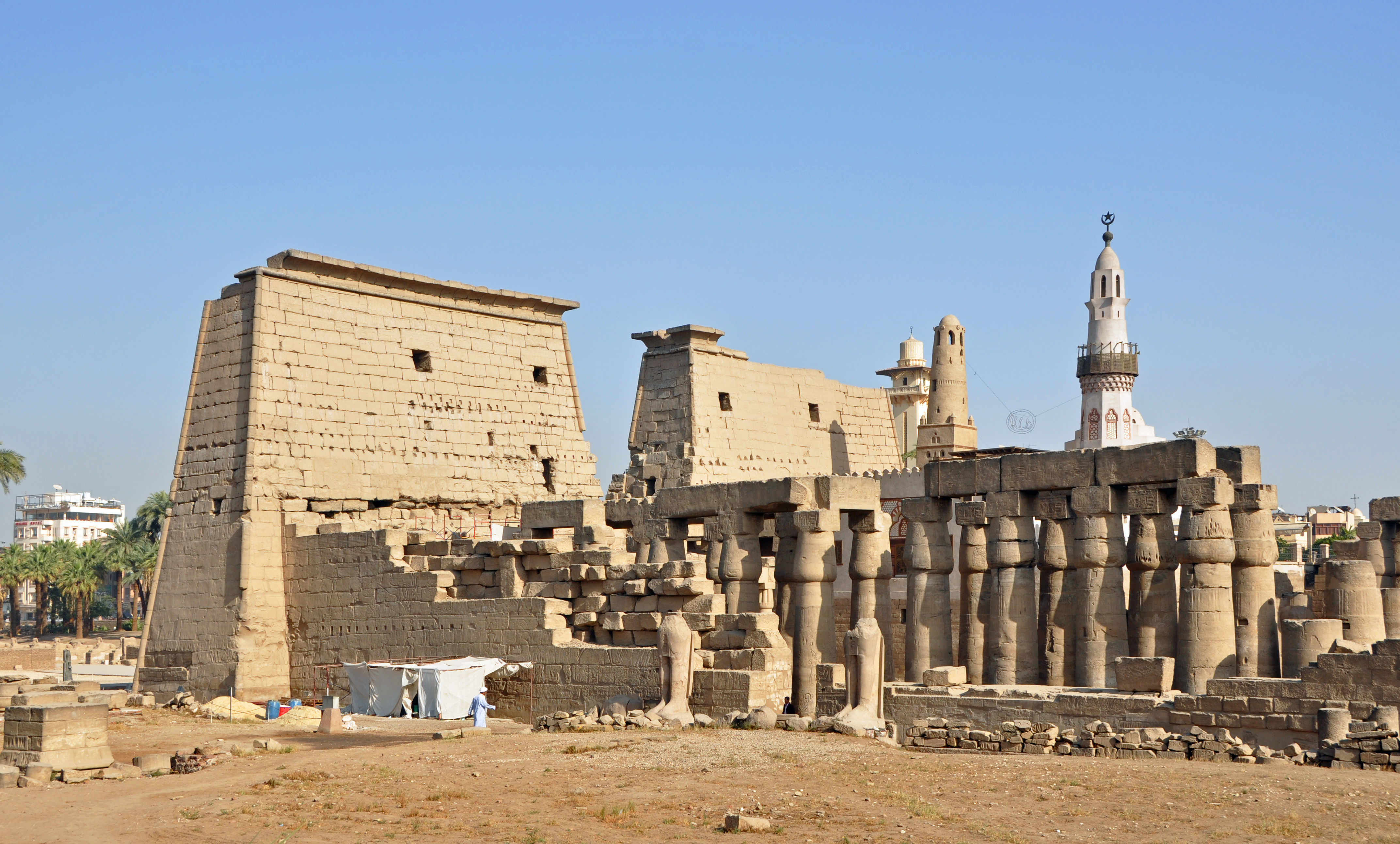
Luxor Temple
Luxor Temple is the ancient temple on the bank of the Nile. It is at its most beautiful at night, when the lights shine on the columns.
Luxor Temple is one of the most famous ancient temples of Egypt, on the east bank of the Nile, in the centre of the modern city of Luxor. The temple was built from about the fourteenth century before Christ under Pharaoh Amenhotep the Third, and was extended by later pharaohs, from Tutankhamun and Ramses the Second to Alexander the Great, over many centuries, forming a temple complex with courts, huge stone columns, statues and reliefs telling of the religious festivals of ancient Thebes. Luxor Temple is a component of the Ancient Thebes with its Necropolis World Heritage site, inscribed by UNESCO in nineteen seventy-nine, reference eight seven, under criteria (i), (iii) and (vi), together with the Karnak temple, the Valley of the Kings and the Valley of the Queens.
Quick Facts
- Location: an ancient Egyptian temple, a component of the Ancient Thebes with its Necropolis World Heritage site
- Position: on the east bank of the Nile, in the centre of the city of Luxor, Egypt, at about twenty-five degrees forty-two minutes north and thirty-two degrees thirty-eight minutes east
- UNESCO: a World Heritage site from 1979, reference eight seven, criteria (i), (iii) and (vi), together with the Karnak temple and the Theban necropolis
- Built: begun about the fourteenth century before Christ under Amenhotep the Third, extended by Tutankhamun, Ramses the Second and Alexander the Great
- Highlights: the court of Ramses the Second with huge statues, the colonnade of Amenhotep the Third, the Avenue of Sphinxes to Karnak, the Abu el-Haggag Mosque inside the temple and the lights at night
- Note: the temple opens in the evening and is one of the most beautiful monuments of Luxor at night, so the traveller should check the current opening hours before the trip
- Nearest separate World Heritage: the Nubian Monuments, reference eight eight, about three hundred and eighty-eight kilometres to the south-south-west
- Famous for: the night visit, when the lights shine on the columns and the statues
Travel to Luxor Temple
The experience most travellers seek at Luxor Temple is the visit at night, when the lights shine on the stone columns, statues and reliefs, and the temple becomes one of the most beautiful monuments of Egypt after the sun sets. In the evening, when the temperature falls after a hot day, the traveller walks through the court of Ramses the Second, the colonnade of Amenhotep the Third and the sanctuary, with yellow light shining on the sandstone, creating a magical scene that the daytime does not have. The keyword “templo de luxor de noche” reflects this experience: Spanish-speaking travellers search for information about visiting Luxor Temple at night, and Luxor Temple is one of the few Egyptian monuments open in the evening with a lighting system designed to bring out the architecture.
The traveller should come to the temple at sunset, to see the temple change from daylight to night light, and should check the current opening hours before the trip, because the hours can change by season. In the daytime, the traveller visits Luxor Temple to see the details of the reliefs and statues under the sunlight, when the carvings on the stone columns and the temple walls are clearest. The court of Ramses the Second, with six huge statues of the pharaoh and a tall pylon, is the first place the traveller sees when entering the temple, and it is the place most travellers choose for photographs.
One of the two stone obelisks of Ramses the Second still stands at the temple, while the other was taken to Paris and set up at the Place de la Concorde in the nineteenth century, a story that the local guides often tell the traveller. The colonnade of Amenhotep the Third, with tall stone columns and reliefs describing the Opet Festival, is the most impressive area of the temple, when the traveller walks between the stone columns and imagines the procession of the god Amun passing here more than three thousand years ago.
The Abu el-Haggag Mosque, in the court of the temple, is a special attraction, when the traveller sees a working mosque standing in the middle of an ancient Egyptian temple, with a minaret rising between the stone columns. The mosque was built in the thirteenth century on the site of an old Christian church, and the annual festival of the saint Abu el-Haggag, with a boat procession through the streets of Luxor, is one of the most important traditional festivals of the city. The traveller should respect the working mosque, dress modestly and ask permission before taking photographs inside the mosque.
The traveller usually combines Luxor Temple with the Karnak temple, about two point seven kilometres to the north along the Avenue of Sphinxes, in the same day, with the morning at Karnak and the afternoon at Luxor Temple, then staying until the evening to see Luxor Temple under the lights. From Luxor Temple, the traveller can also take a felucca boat on the Nile in the afternoon, seeing the temple from the water and the sunset over the river, an experience many travellers consider the most beautiful of Luxor. The next day, the traveller crosses the river to the west bank to visit the Valley of the Kings, the Valley of the Queens and the temple of Queen Hatshepsut, completing the journey through ancient Thebes.

Pylons and obelisk at Luxor temple — CC BY-SA 3
Geography of Luxor Temple
Luxor Temple lies on the east bank of the Nile, in the centre of the modern city of Luxor, at about twenty-five degrees forty-two minutes north and thirty-two degrees thirty-eight minutes east. The city of Luxor, the modern name of ancient Thebes, lies about seven hundred kilometres south of the capital Cairo along the Nile, and it is one of the most important tourist centres of Egypt. The east bank of Luxor is where the city lives, with Luxor Temple, the Karnak temple, museums and the market, while the west bank is the city of the dead, with the Valley of the Kings, the Valley of the Queens and the temple of Queen Hatshepsut. Luxor Temple lies right by the river, near the boat landing and the riverside promenade, so the traveller can reach the temple on foot from most hotels in the city.
Luxor Temple joins with the Karnak temple by the Avenue of Sphinxes, a road about two point seven kilometres long with hundreds of sphinx statues on both sides, once the route of the Opet Festival, when the statue of the god Amun was carried from Karnak to Luxor. The avenue was once hidden under the modern city for many centuries, and was only excavated and restored in recent decades, with a plan to extend the boundary of the World Heritage site to include the avenue. From Luxor Temple, the traveller can walk along the Avenue of Sphinxes north to the Karnak temple, a journey through the centre of ancient Thebes, with monuments and museums on both sides of the road.
The climate of Luxor is a hot desert climate, with very hot summers and mild winters, and it is one of the hottest places in Egypt. The summer temperature often passes forty degrees, sometimes reaching more than forty-five degrees, while the winter daytime is around twenty degrees and the nights are cool. The annual rainfall is almost zero, and the sun is strong all year round, making a visit to the outdoor monuments at midday in summer very tiring. The best time to come to Luxor is from October to April, when the daytime temperature is moderate for walking outdoors, and the evenings are cool, suitable for visiting Luxor Temple at night.
The traveller should carry a hat, sun cream and drinking water when visiting the temple in the daytime, and a light jacket for the evening, because the temperature falls quickly after the sun sets. The Nile is the most important geographical setting of Luxor Temple, when the temple was built to face the river, where the statue of the god Amun landed in the Opet Festival, and where the traveller today takes a felucca boat to see the temple from the water. The riverbank before the temple is a promenade area, with cafes, restaurants and a boat landing, where the traveller watches the sunset over the Nile and sees Luxor Temple from far away.
In the evening, the light from the temple reflects on the river, creating a scene that the traveller often describes as one of the most beautiful of Luxor. The Nile is also the main transport route joining Luxor with the other cities of Egypt, with cruise boats running the route from Luxor to Aswan, past the temples along the river. The central position of Luxor Temple makes it the natural starting point for the journey through Luxor, before the traveller goes to Karnak and across the river to the west bank.
The Nile divides Luxor into two cities, and the division is the key to the whole site. The east bank, where the temple stands, was the city of the living, with the temples, the palaces and the houses of the people, and the sun rose over it every morning. The west bank, across the river, was the city of the dead, with the tombs, the temples of the dead and the valley where the kings were buried, and the sun set over it every evening. The temple on the east bank faces the west bank across the river, and the Avenue of Sphinxes runs from the temple to Karnak, joining the two great temples of the living city.
History of Luxor Temple
The history of Luxor Temple began about the fourteenth century before Christ, under Pharaoh Amenhotep the Third, who built the main part of the temple of the god Amun, the protecting god of Thebes. According to UNESCO, the temple of Amenophis the Third at Luxor is one of the most refined masterpieces of Egyptian architecture, and one of the largest religious buildings ever built. The temple was built on the site of an older temple, and Amenhotep the Third built the great colonnade, the inner court and the sanctuary area, creating the layout that later pharaohs continued to extend. The position of the temple, right by the Nile and in the centre of Thebes, shows its important role in the religious life of the city, when Thebes was the religious capital of Egypt for much of ancient Egyptian history.
After Amenhotep the Third, later pharaohs continued to build and extend Luxor Temple, among them Tutankhamun, who restored the temple after the Amarna period, when Pharaoh Akhenaten had closed the temples of Amun, and Ramses the Second, who built the great court with huge statues of himself and two tall pylons, creating the facade that the traveller sees today. Alexander the Great, when he conquered Egypt in the fourth century before Christ, also built in the temple, with a small chapel in the sanctuary area, showing that Luxor Temple continued to be an important religious centre even under Greek rule. Over many centuries, Luxor Temple was extended many times, and its buildings are evidence of the continuity of Egyptian religion from the Middle Kingdom to the beginning of the Christian period, as UNESCO notes in criterion (vi) of the World Heritage site.
Luxor Temple is tied to the Opet Festival, one of the most important festivals of ancient Thebes, when the statue of the god Amun was carried from the Karnak temple to Luxor Temple along the Avenue of Sphinxes, in a procession lasting many days, with boats, music and people taking part. The Opet Festival was an occasion for the pharaoh to reaffirm his divine power, when the statue of the god Amun visited Luxor Temple and the pharaoh was reborn in ritual. The reliefs in Luxor Temple describe the Opet Festival, with divine boats, musicians and people, and they are one of the most important sources about the religious festivals of ancient Egypt. The Avenue of Sphinxes joining the two temples was the route of the festival, and the restoration of the avenue in recent years has helped the traveller to imagine the scale of the Opet procession.
In the Roman period, Luxor Temple was used as a military camp, with Roman buildings added inside the temple, and later, when Christianity spread to Egypt, part of the temple was turned into a church. In the thirteenth century, the Abu el-Haggag Mosque was built right in the court of the temple, on the site of an old Christian church, and this mosque is still active today, with the annual festival of the saint Abu el-Haggag held in the temple. The presence of the mosque in an ancient Egyptian temple, together with the Roman and Christian buildings before it, shows that Luxor Temple has been used continuously through many religions and periods, from ancient Egypt to Islam, a continuous history of use that few monuments in the world have.
The ancient city of Thebes, which includes Luxor Temple, was once one of the richest and most important cities of ancient Egypt, with a population that may have reached fifty thousand people around fifteen hundred to one thousand before Christ, and it was the capital of an empire stretching from the Euphrates to northern Sudan. After Thebes declined, Luxor Temple was gradually covered by sand and the modern city, and it was only excavated in the nineteenth century, when archaeologists began to clear the sand from the temple and reveal the stone columns and statues. In nineteen seventy-nine, UNESCO inscribed Ancient Thebes with its Necropolis on the World Heritage List, with Luxor Temple as one of the two temples on the east bank of the property, together with the Karnak temple, and the property has an area of seven thousand three hundred and ninety hectares.

Luxor (Egypt): Temple square, with Abu Haggag mosque and the pylon of Rameses II — CC BY 3
Notable Places in Luxor Temple
The court of Ramses the Second is the first place the traveller sees when entering Luxor Temple, with six huge statues of the pharaoh and a tall pylon, together with one stone obelisk still standing in place. The court was built under Ramses the Second, and it is the place where the traveller takes the most photographs of the temple, especially in the evening, when the lights shine on the stone statues. The other obelisk of Ramses the Second was taken to Paris and set up at the Place de la Concorde, a story that the local guides often tell the traveller.
The colonnade of Amenhotep the Third is the most impressive area of Luxor Temple, with tall stone columns and reliefs describing the Opet Festival, when the statue of the god Amun was carried from Karnak to Luxor. The colonnade was built in the fourteenth century before Christ, and it is one of the most refined masterpieces of Egyptian architecture, according to UNESCO. The traveller walking between the stone columns in the evening, when the lights shine on the reliefs, will feel the sacred atmosphere of the ancient temple.
Walking from Luxor Temple to the north, the traveller steps onto the Avenue of Sphinxes, where hundreds of sphinx statues with human heads and lion bodies stand in two rows along the old procession route. The road once disappeared under the houses of the modern city, and it only appeared after many years of excavation, when the archaeologists cleared layer after layer of earth to join the two great temples of Thebes. Today, walking the whole avenue is the slowest way to feel the scale of the Opet Festival, when the procession of the god Amun moved between Karnak and Luxor for many days.
The minaret of the Abu el-Haggag Mosque rises between the sandstone columns, creating the strangest skyline of Luxor Temple, where ancient Egyptian and Islamic architecture stand side by side in the same frame. The mosque was built in the thirteenth century, when Luxor Temple had partly sunk under the sand, and the people of Luxor still come here to pray every day, so the ancient temple never became a dead museum. Every year, the festival of the saint Abu el-Haggag brings a boat procession through the streets of Luxor, recalling the boat procession of the god Amun in the ancient Opet Festival, and it is an occasion when the whole city comes out into the streets.
The sanctuary area lies at the innermost part of Luxor Temple, where the statue of the god Amun was placed in the rituals, and it is the holiest place of the temple. The area was built under Amenhotep the Third and extended by Alexander the Great with a small chapel, showing that the temple continued to be an important religious centre even under Greek rule. The traveller comes to the sanctuary to see where the most important rituals of ancient Thebes took place.
Frequently Asked Questions
Where is Luxor Temple?
On the east bank of the Nile, in the centre of the city of Luxor, Egypt, at about twenty-five degrees forty-two minutes north.
When was Luxor Temple built?
From about the fourteenth century before Christ under Amenhotep the Third, extended by Tutankhamun, Ramses the Second and Alexander the Great.
What does “templo de luxor de noche” mean?
A Spanish search phrase for visiting Luxor Temple at night, when the lights shine on the columns and statues.
Can I visit Luxor Temple at night?
Yes, the temple opens in the evening with lighting that brings out the architecture, best at sunset.
Where does the Avenue of Sphinxes lead from Luxor Temple?
To the Karnak temple, about two point seven kilometres to the north, with hundreds of sphinx statues along the road.
What is the mosque inside Luxor Temple?
The Abu el-Haggag Mosque, built in the thirteenth century on an old Christian church, still active today.
Verified
- Luxor Temple lies on the east bank of the Nile, in the centre of the city of Luxor, Egypt, a component of the Ancient Thebes with its Necropolis World Heritage site, inscribed by UNESCO in 1979, reference 87, criteria (i), (iii) and (vi).
- The temple was built from about the fourteenth century before Christ under Amenhotep the Third, and was extended by Tutankhamun, Ramses the Second and Alexander the Great; the temple of Amenophis the Third at Luxor is one of the most refined masterpieces of Egyptian architecture.
- The Ancient Thebes property has two temples, Karnak and Luxor, on the east bank and the archaeological area on the west bank, with an area of 7,390 hectares, and Thebes lies about 700 kilometres south of Cairo.
- Luxor Temple, Wikidata Q319841, an ancient Egyptian temple, coordinates 25.7 degrees north, 32.6392 degrees east — checked through the Wikidata API on 24/11/2026.
- Luxor Temple IS part of Ancient Thebes with its Necropolis, reference 87; the registry flag unesco:false is wrong.
Sources
- UNESCO, Ancient Thebes with its Necropolis, reference 87 — the property, criteria (i), (iii) and (vi), Luxor Temple and Karnak Temple, area of the property — checked 20/11/2026.
- Wikidata, Luxor Temple Q319841 — type, description and coordinates — checked 20/11/2026.
- TheTerraAtlas registry, entities-p4.json: TA-L4-luxor-temple, Q-ID Q319841, coordinates and primary keyword — checked 24/11/2026.
Unverified
- The exact length of the Avenue of Sphinxes, about two point seven kilometres, is given from popular travel sources and was not verified by official measurement on the UNESCO site at the time of writing.
- The exact evening opening hours of Luxor Temple were not checked directly on the official site of the managing authority at the time of writing, so the article gives no specific opening hours and advises the traveller to check again before the trip.
- The ticket price for Luxor Temple was not checked directly on the official site, so the article gives no specific ticket price.
- The exact year the Abu el-Haggag Mosque was built, the thirteenth century, is given from popular sources and was not verified from an official archaeological source.
Illustrations
- Hero: Luxor Temple. Free image: https://upload.wikimedia.org/wikipedia/commons/e/e0/Luxor_Temple_R04.jpg — CC BY 3.
- In body, Luxor Temple: Luxor (Egypt): Temple square, with Abu Haggag mosque and the pylon of Rameses II. Free image: https://upload.wikimedia.org/wikipedia/commons/4/44/Luxor_Temple_Square_R01.jpg — CC BY 3.
- In body, Luxor Temple: Pylons and obelisk at Luxor temple. Free image: https://upload.wikimedia.org/wikipedia/commons/0/0f/Pylons_and_obelisk_Luxor_temple.JPG — CC BY-SA 3.