
Memphis: Egypt’s First Capital and Its Necropolis
Memphis was the first capital of ancient Egypt, and its necropolis is the greatest of the Old Kingdom. The colossus of Ramesses II still lies at Mit Rahina.
Today the city is a field of ruins around the village of Mit Rahina, about 22 kilometres south of central Cairo, and the road from the capital takes under an hour when traffic is kind. The site holds the open-air museum, the remains of the Temple of Ptah, and the starting point for the pyramid fields that stretch north to Giza and south to Dahshur. Most visitors come for a short morning stop, but the ground covers three thousand years of history, and a slow walk reads like a timeline of the Old Kingdom.
The name of the city is older than the name of the country, and the country may have taken its name from the city. The Temple of Ptah was called Hut Ka Ptah in Egyptian, the house of the soul of Ptah, and the Greeks turned that name into Aigyptos, which became Egypt. Memphis was therefore the place where the name of a whole land began, and the ruins at Mit Rahina are the ground where that name was born.
Quick Facts
- Place: Ancient capital of Egypt, at the village of Mit Rahina, Giza Governorate
- Coordinates: 29 degrees 51 minutes north, 31 degrees 15 minutes east
- Founded: Traditionally about 3100 BC, at the unification of Upper and Lower Egypt
- Capital years: The Old Kingdom, about 2686 to 2181 BC
- Chief god: Ptah, god of creation and patron of craftsmen
- Heritage listing: Memphis and its Necropolis, UNESCO ref 86, inscribed 1979
- Signature object: The fallen limestone colossus of Ramesses II
- Time needed: One to two hours at the museum, a full day with Saqqara and Dahshur
Geography of Memphis
The Memphis site sits on the west bank of the Nile, at the edge of the floodplain where the green fields meet the desert plateau. The village of Mit Rahina stands on top of the ancient city, so houses, palm groves, and canals share the ground with temple walls and statue bases. The open-air museum lies at the centre of the village, and the fields around it hide the rest of the city under soil and cultivation. From the museum, the pyramids of Saqqara rise about four kilometres to the west, and the Bent Pyramid stands about seven kilometres to the south.
The necropolis of Memphis runs in a long band along the desert edge, from Giza in the north to Dahshur in the south, and it holds more than thirty eight pyramids and more than nine thousand rock cut tombs. The band is not one cemetery but a chain of burial grounds, each attached to a pyramid or a temple, and each belonging to a different dynasty. Giza holds the three great pyramids, Saqqara holds the Step Pyramid and the Serapeum, Abusir holds the sun temples, and Dahshur holds the Bent Pyramid and the Red Pyramid. The ground between them is full of smaller tombs, causeways, and chapels, many still unexcavated.
Memphis itself stood on the floodplain, beside the Nile, where the river made the land rich enough to feed a capital. The Temple of Ptah stood at the heart of Memphis, and the palace of King Apries stood on a rise at the northern edge, looking over the fields. Canals and basins connected the temple to the river, and boats brought stone, grain, and offerings into the city. The walls of the city are gone, and only the temple enclosures and the statue bases mark where the streets once ran.
The river made the city possible, and the desert made the necropolis possible. The floodplain gave grain, the river gave transport, and the plateau gave dry ground where tombs would stay undisturbed for thousands of years. Memphis sat at the hinge between the two, and the necropolis sat on the edge of the desert, where the dead would stay dry. The contrast between green fields and pale sand is still the first thing a visitor sees, and it explains the whole layout of the site.
The village of Mit Rahina sits directly on the ruins of Memphis, and the archaeology of the city continues under its streets and gardens. Excavators have worked at the site since the nineteenth century, and the ground still gives up temple blocks, statues, and inscriptions. The open-air museum holds only a part of what has been found, and much of the ancient city remains buried under the village. The work is slow, because the archaeologists cannot dig under inhabited houses, and the water table rises close to the surface.
The Nile flood shaped the life of Memphis, and the city depended on the rise of the river each summer. The flood brought water and silt to the fields, and the canals of the city carried the water into the temple basins. The temple of Ptah had its own sacred lake, and the festivals of the god followed the rhythm of the flood. The flood no longer reaches the city, because the Aswan dam controls the river, and the fields around Mit Rahina are watered by canals instead.
The southern capital at Thebes, now Luxor, stood about 480 kilometres upriver from Memphis, and the two cities divided the country between them for much of Egyptian history. Memphis was the northern capital, the seat of administration and the home of the craftsmen, while Thebes was the southern capital, the home of the god Amun and the great temples of the New Kingdom. The road between them followed the Nile, and boats carried the king, the court, and the stone of the temples up and down the river.
The site is hot and dusty for most of the year, and the best months to walk it are November to March, when the air is cool and the light is soft. Summer days reach well over 35 degrees, and the midday sun makes the open ground hard to cross. Winter mornings are clear and calm, and the low sun throws long shadows across the statue bases. Wind picks up in the afternoon, and sand can sting the eyes, so a hat and water matter more than a guidebook.

The Colossus of Ramses II in the palm grove at Memphis, Egypt — Public domain
History of Memphis
Tradition says the city was founded about 3100 BC by the first king, Menes, at the moment when Upper and Lower Egypt were joined into one kingdom. The king built his capital at the narrow point where the Nile valley meets the Delta, and he named it Ineb Hedj, the White Wall, after the whitewashed brick of its walls. The Greeks later called the city Memphis, after the name of a pyramid, and the name stuck. UNESCO gives the traditional date as 3000 BC, and the difference between the two dates is a matter of convention, not of fact.
Memphis was the capital of the Old Kingdom from about 2686 to 2181 BC, and in those centuries Memphis directed the building of the pyramids and the administration of the whole country. The king ruled from the palace, the viziers ran the bureaucracy, and the priests of Ptah ran the temple that stood at the centre of the city. Ptah was the god of creation, the patron of craftsmen, and the lord of the city, and his temple, Hut Ka Ptah, gave its name to the whole country when the Greeks turned it into Aigyptos. Memphis was the home of the royal court, the workshops, and the granaries that fed the pyramid builders.
Memphis kept its importance long after the capital moved, and kings of every age built at Memphis and buried their dead in its necropolis. Ramesses II, who ruled from about 1279 to 1213 BC, filled the Temple of Ptah with statues, and two colossi of the king stood at the southern gate of the temple. Alexander the Great was crowned at Memphis in 332 BC, and the Ptolemies kept the city as a ceremonial capital long after Alexandria became the seat of government. The priests of Ptah stayed powerful through the Middle Kingdom and the New Kingdom, and the city remained the religious heart of the north.
The New Kingdom brought a second flowering to Memphis, and Ramesses II made Memphis his northern seat while Thebes held the south. The king rebuilt the Temple of Ptah on a grand scale, and the workshops of the city produced the statues, the jewellery, and the furniture that filled the royal tombs. The Apis bulls were buried at Saqqara in great granite sarcophagi, and the cult of the bull made the necropolis a place of pilgrimage. The priests of Ptah kept their power through the whole of the New Kingdom, and the city stayed the religious heart of the north even when the court moved.
The Apis bulls were the living gods of Memphis, and their burials at Saqqara were among the grandest ceremonies of the city. Each bull lived in the temple of Ptah, was worshipped as the herald of the god, and was buried in a great granite sarcophagus in the underground galleries of the Serapeum. The galleries run for hundreds of metres under the desert, and the sarcophagi weigh tens of tonnes each. The cult lasted from the New Kingdom into the Roman period, and the last bull was buried long after the city itself had faded.
Memphis declined after the foundation of Fustat in the seventh century, and its stone was carried away to build the new capital and then Cairo. The temples were dismantled, the palaces were stripped, and the statues were buried under the mud of the floodplain. By the Middle Ages Memphis was a ruin, and only the village of Mit Rahina kept the name alive. The necropolis fared better than the city, because the tombs and pyramids stood on the dry plateau, and the desert kept them standing while the city below turned to dust.
The ruins came back to light in 1820, when Giovanni Battista Caviglia found the two colossi of Ramesses II at the southern gate of the Temple of Ptah. The limestone colossus stayed at Mit Rahina, lying on its back under a shelter, while the red granite twin went to Ramses Square in Cairo in 1955 and then to the Grand Egyptian Museum in 2018. The alabaster sphinx was found in 1912, and the open-air museum opened around the colossus in 1985. Excavation at Memphis continues, and new fragments of the temple and the palace still come out of the ground.
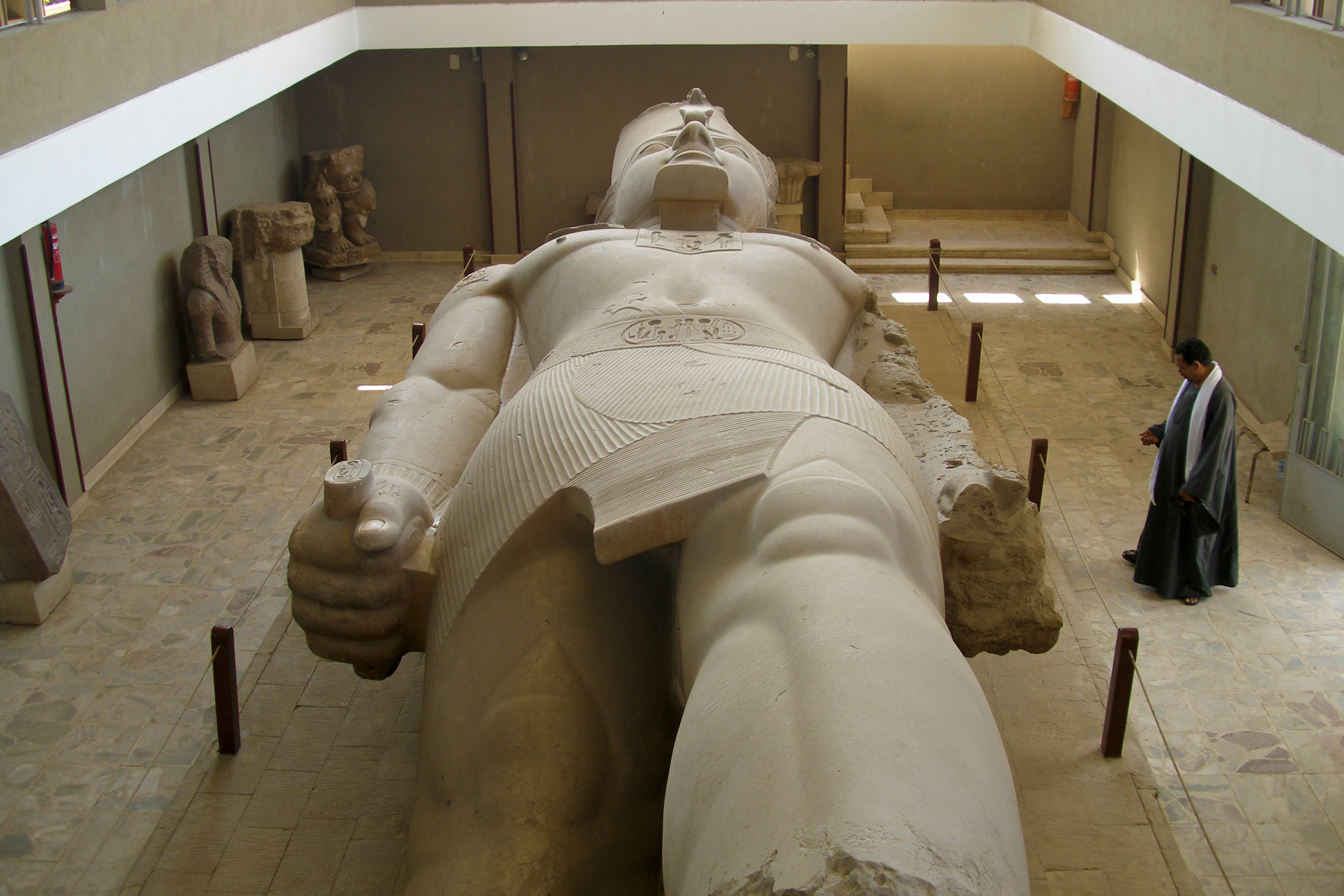
The colossus of Pharaoh Ramesses II at Memphis, Egypt — CC BY 4
Travel to Memphis
Most visitors reach Memphis from Cairo or Giza as part of a half day trip that also covers Saqqara and Dahshur, and the three sites fit together well because they belong to the same necropolis. A car with a driver is the easiest way to move between them, and the drive from central Cairo takes about an hour in light traffic. Public transport reaches the village by bus and shared taxi, but the connections are slow, and the last stretch is best done on foot. The museum opens in the morning, and the first hour after opening is the quietest time to see the colossus.
The open-air museum at Memphis is a garden of statues, sarcophagi, column pieces, and building blocks, and the colossus lies in a roofed hall with a walkway along one side. The alabaster sphinx stands outside, and the garden paths lead past granite blocks and the remains of the Temple of Ptah. There is little shade, and the ground is uneven, so good shoes and water matter. A guide is useful for the temple remains, because the stones carry no labels that explain what they are.
Bring water, sun protection, and cash for the ticket, because Memphis has few services beyond the gate. The museum garden has almost no shade, and the walk between the colossus hall and the temple remains crosses open ground. Comfortable shoes matter more than a camera, and the morning light is the best for photographs of the sphinx. A small bag with water and a hat is enough, and the village shops near the gate sell drinks and snacks.
Pair the visit with Saqqara, about four kilometres west, where the Step Pyramid of Djoser stands, and with Dahshur, where the Bent Pyramid shows the moment when builders learned to change the angle of a pyramid. The three sites together tell the story of the pyramid from its first stone step to its final smooth form, and the drive between them takes only minutes. A morning at Memphis, a midday at Saqqara, and an afternoon at Dahshur make a full day, and the light at Saqqara in the late afternoon is the best of the three.
Tickets are bought at the gate, and a guide can be hired at the entrance or arranged with the driver. Photography is allowed in the garden, and the colossus hall has good light in the morning. There are small shops and a cafe near the gate, and the village has a few places to eat. The site is open every day, and the museum closes in the late afternoon.
Notable Places in Memphis
The Colossus of Ramesses II
The limestone colossus is the centrepiece of the museum, about ten metres long as it lies on its back, and it once stood at the southern gate of the Temple of Ptah. Caviglia found it face down in mud in 1820, and a roofed hall with a raised walkway now lets visitors look down at the whole figure. The crown, the face, and the broad chest survive in fine detail, and the missing lower legs are the reason the statue can never stand again.
The Alabaster Sphinx
The sphinx stands in the open air near the colossus, carved from a single block of alabaster, and it weighs about eighty tonnes. It was found in 1912, and it once stood outside the Temple of Ptah, guarding the approach to the sanctuary. The stone is pale and translucent in the morning light, and the face is one of the best preserved portraits of the New Kingdom.
The Temple of Ptah
The temple was the heart of the city, and its enclosure still covers a large part of the village. The walls and column bases show the scale of the sanctuary, and the small museum garden holds blocks from the temple that carry the names of kings. The god Ptah was the patron of craftsmen, and the temple workshops produced the statues and the ornaments that filled the city.
The Palace of Apries
The palace stands on a rise at the northern edge of the site, and its terrace once looked over the whole city. The building was the residence of King Apries, who ruled in the sixth century BC, and its stone terrace and column bases survive. The view from the terrace is the best place to see how the city sat between the river and the desert.
Saqqara
Saqqara lies about four kilometres west of the Memphis museum, and it holds the Step Pyramid of Djoser, the first pyramid ever built. The pyramid was raised in the third dynasty, and its six steps mark the moment when builders first piled stone into a pyramid shape. The Serapeum nearby holds the great granite sarcophagi of the Apis bulls, and the tombs around it carry some of the finest reliefs of the Old Kingdom.
Dahshur and the Bent Pyramid
Dahshur lies south of the museum, and the Bent Pyramid stands there as the record of a building experiment. The builders changed the angle of the pyramid halfway up, so the lower half rises steeply and the upper half slopes gently, and the result is the most distinctive silhouette in the whole necropolis. The Red Pyramid nearby shows the lesson learned, and the two together explain how the smooth sided pyramid was born.
Frequently Asked Questions
Is Memphis the same as the Memphis in Tennessee?
No. The Egyptian city is about five thousand years old, and the American city took the name from it in the nineteenth century.
How far is Memphis from Cairo?
About 22 kilometres south of the centre in a straight line, and the drive takes under an hour in light traffic.
Is Memphis a UNESCO World Heritage site?
Yes. The city and its necropolis were inscribed in 1979 as part of the Memphis and its Necropolis listing, ref 86.
What is the best time to visit Memphis?
November to March brings cool air and soft light, and mornings are the quietest time at the museum.
How long do I need at Memphis?
One to two hours covers the museum and the temple remains, and a full morning covers Saqqara and Dahshur too.
Can I visit Memphis, Saqqara, and Dahshur in one day?
Yes. The three sites belong to the same necropolis, and a car with a driver covers all three comfortably in a day.
Verified
- Memphis was traditionally founded about 3100 BC at the unification of Egypt, and UNESCO gives the traditional date as 3000 BC — whc.unesco.org/en/list/86/, checked 23 November 2026
- The necropolis runs from Giza to Dahshur and holds more than thirty eight pyramids and more than nine thousand rock cut tombs — whc.unesco.org/en/list/86/, checked 23 November 2026
- Memphis and its Necropolis was inscribed in 1979 under criteria (i)(iii)(vi) — whc.unesco.org/en/list/86/, checked 23 November 2026
- Caviglia found the two colossi of Ramesses II at the southern gate of the Temple of Ptah in 1820, and the limestone figure measures about ten metres as it lies — en.wikipedia.org/wiki/Giovanni_Battista_Caviglia, checked 23 November 2026
- The alabaster sphinx was found in 1912 and weighs about eighty tonnes — memphis.vi.md, checked 19 November 2026
- The red granite twin of the limestone colossus stood in Ramses Square from 1955 and moved to the Grand Egyptian Museum in 2018 — egypt-museum.com/colossal-ramesses-ii-at-the-grand-egyptian-museum/, checked 23 November 2026
- The open-air museum at Mit Rahina opened in 1985 — egyptcompasstours.com/destinations/giza/memphis-open-air-museum, checked 23 November 2026
- Distances from the site are straight-line haversine figures from the registry coordinates 29.844667 north, 31.250917 east: Saqqara 4.5 km, Bent Pyramid 7.3 km, Giza plateau 18.7 km, central Cairo 22.3 km — computed 23 November 2026
Sources
- whc.unesco.org/en/list/86/
- en.wikipedia.org/wiki/Giovanni_Battista_Caviglia
- egypt-museum.com/colossal-of-ramesses-ii-at-memphis/
- egyptcompasstours.com/destinations/giza/memphis-open-air-museum
- memphis.vi.md
Unverified
- The exact original height of the limestone colossus is not settled; guides give figures above thirteen metres, while the surviving figure measures about ten metres as it lies
- The claim that the city was fully abandoned in the seventh century is an oversimplification; settlement at Mit Rahina continued, and the decline was gradual
- The open-air museum is said in some guides to date from the 1950s, but the museum itself gives 1985 as its opening year
Illustrations
- Hero: View of Memphis. Free image: https://upload.wikimedia.org/wikipedia/commons/a/a3/Memphis%2C_Ramses_II%2C_Ancient_Egypt.jpg — CC BY 4.
- In body, Memphis: The Colossus of Ramses II in the palm grove at Memphis, Egypt. Free image: https://upload.wikimedia.org/wikipedia/commons/9/97/Egypt._Memphis.Colossus_of_Ramases_II%28i.e.%2C_Ramses_II%29_in_Memphis_palm_grove_LOC_matpc.23070.jpg — Public domain.
- In body, Memphis: The colossus of Pharaoh Ramesses II at Memphis, Egypt. Free image: https://upload.wikimedia.org/wikipedia/commons/c/cf/Memphis%2C_Pharaoh_Rameses_II%2C_Ancient_Egypt.jpg — CC BY 4.