
Biskra — Queen of the Ziban Oases at the Gate of the Sahara
Biskra is an oasis city in north-eastern Algeria, where the Aurès mountains give way to the Sahara. It is called the Queen of the Ziban oases.
Travellers search for Biskra with phrases such as “voyage biskra”, “voyage a biskra” and “prix billet alger biskra en dinars”, and this guide follows that intent: the position and scenery of Biskra, the history of the oasis city, the sights around Biskra, and how to reach Biskra from Algiers and move around the region. Biskra is the main city of the Ziban region and the capital of Biskra Province, about four hundred kilometres south-east of Algiers, and it is the natural base for the palm groves, the gorges and the hot springs of the Ziban.
Quick Facts
- Place: North-eastern Algeria, at the foot of the Aurès mountains, where the Sahara begins, about four hundred kilometres south-east of Algiers.
- People: Two hundred and five thousand six hundred and eight residents at the census of two thousand and eight, with a metropolitan area of about three hundred and seven thousand nine hundred and eighty-seven in two thousand and seven.
- Height: Eighty-seven metres above sea level, one of the lowest cities of Algeria.
- Name: “Queen of the Ziban Oases”, “Gate of the Sahara” and “Nice of the Sahara”.
- Role: Capital of Biskra Province and main city of the Ziban region.
- Marks: The palm groves of the Ziban, the Tolga oasis with Deglet Nour dates, the El Kantara gorge, the Sidi Okba Mosque and the hot springs.
- Distances: About one hundred and fourteen kilometres south-west of Batna, about two hundred and twenty kilometres north of Touggourt, about two hundred and forty-two kilometres from Constantine.
- Airport: Mohamed Khider Airport, code BSK, with domestic and international flights.
- Best season: October to April, when the weather is cool and suits the oases and the gorges.
- Further south: Timimoun, the red oasis of the Gourara, lies far to the south-west and suits a separate desert trip.
Geography of Biskra
Biskra lies in north-eastern Algeria, at the foot of the Aurès mountains and the Zab mountains, where the ranges of the Saharan Atlas give way to the great Sahara desert. The city stands at eighty-seven metres, one of the lowest cities of Algeria, with green oases around it and dunes to the south. This position makes Biskra a crossroads between the cities of the north and the south, with trade routes and caravans passing through since ancient times.
The Biskra River flows through the city, rising in the Aurès mountains and running to the salt lake of Chott Melrhir, after a course of about one hundred and ninety-four kilometres. The Biskra River is a seasonal river, with strong flow in winter and dry beds in summer, but channels from the river water the oases and the palm gardens around Biskra. The Ziban oases surround Biskra, with more than one hundred and fifty thousand palm trees, and they are the most important source of Deglet Nour dates in Algeria.
The El Kantara gorge lies north of Biskra, a narrow gap through the limestone mountains of the Aurès, forming the natural and climatic boundary between the Tell in the north and the Sahara in the south. The gorge holds an ancient Roman bridge, with high cliffs and a palm valley on the far side, making it one of the most striking landscapes of the Biskra region. Travellers from the north to Biskra pass through the El Kantara gorge, with viewpoints and oasis villages along the way.
The Tolga oasis lies about thirty-five kilometres west of Biskra, and it is the home of the most famous Deglet Nour dates in the world, with more than five hundred thousand palm trees watered by the natural aquifers of the Djedi river basin. Tolga is the date production centre of the Ziban region, with palm gardens, markets and date harvest festivals in November each year. Travellers to Biskra should spend a morning in Tolga, with the palm gardens, the markets and the date packing houses.
The Ziban region has two main parts: Zab Gharbi in the west, with Tolga as its centre, and Zab Chergui in the east, with Sidi Okba as its centre. Sidi Okba is a historic town east of Biskra, with an ancient mosque holding the tomb of Uqba ibn Nafi, one of the oldest Islamic sites of the Maghreb. The Ziban oases hold small villages, palm gardens and hot springs, and the hot springs of Biskra and the nearby towns have been a resort destination since the nineteenth century.
Biskra lies about four hundred kilometres south-east of Algiers, with road and rail links between the two cities, and domestic flights to Mohamed Khider Airport. The city lies about one hundred and fourteen kilometres south-west of Batna, about two hundred and twenty kilometres north of Touggourt, and about two hundred and forty-two kilometres from Constantine. The central position of Biskra in the Ziban region makes the city a transport and trade centre, with roads linking the oases and the cities of the north and the south.
The climate of Biskra is hot desert, with very hot summers and cool winters, and very little rain. Daytime temperatures in summer often pass forty degrees, while winter brings daytime temperatures of about eighteen to twenty-two degrees and nights of about five to eight degrees. The best time to visit Biskra is from October to April, when the weather is cool and suits the oases, the gorges and the hot springs. Carry drinking water, a hat and sun cream when walking in the oases, because the desert sun is strong even in winter.
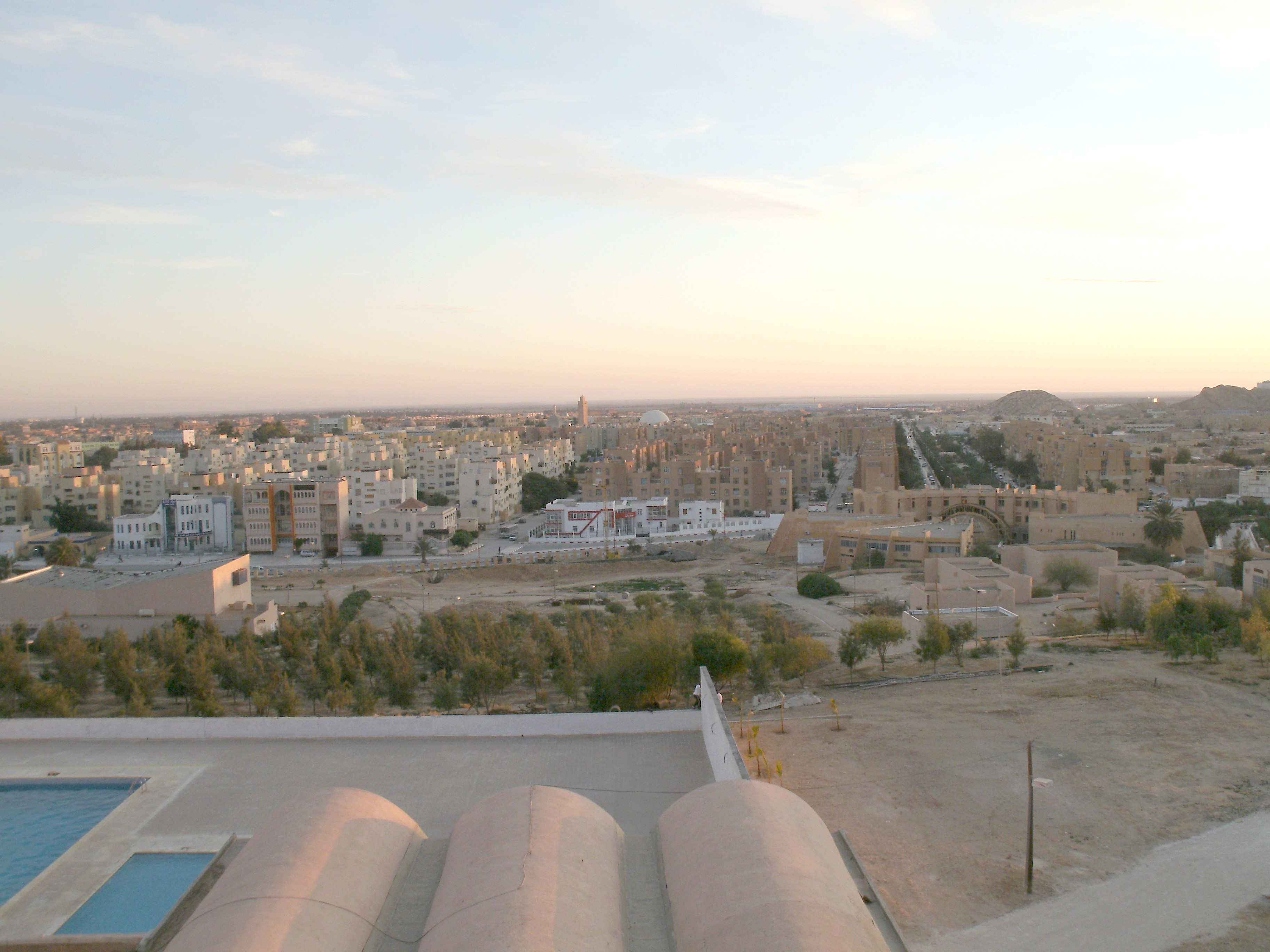
A view of Biskra — CC BY-SA 3
History of Biskra
The history of Biskra begins with the Romans, who called the city Vescera, a city on the trade route between the Roman cities of the north and the Sahara oases of the south. Roman ruins around Biskra, including bridges and water works, show that the city was already an important centre of trade and farming in Roman times. The name Biskra comes from the Roman name Vescera, with changes through the centuries.
Under Islam, Biskra became a centre of trade and religion, with the Sidi Okba Mosque, holding the tomb of Uqba ibn Nafi, one of the first Muslim conquerors of North Africa. The Sidi Okba Mosque is one of the oldest Islamic sites of the Maghreb, with architecture and objects from the seventh century. Biskra was also a centre for caravans and traders, with markets and lodgings for the caravans crossing the Sahara.
In eighteen forty-four, Biskra became a French garrison, with fighting against uprisings in eighteen forty-nine and eighteen seventy-one. Under French rule, Biskra grew into a resort town and the gate of the Sahara, with hotels, hot springs and European quarters. Late in the nineteenth century, Biskra became a centre of art and photography, with artists and photographers such as Émile Frechon, Alexandre Bougault and Rudolf Franz Lehnert coming to Biskra to photograph and paint the oases and the desert.
Biskra was called the “Nice of the Sahara” late in the nineteenth century, because of its mild winter climate, its green oases and its hot springs, which drew European visitors to spend the winter. Hotels and lodges in Biskra grew to serve the visitors, with gardens, pools and spa services. Biskra was also a centre of date production, with palm gardens and date markets, and craft products such as carpets and textiles of the Souafa people.
After Algeria won independence in nineteen sixty-two, Biskra stayed a centre of farming and tourism, with the palm gardens, the hot springs and historic sights. The city grew with new neighbourhoods, universities and industrial areas, but it kept its oases and its old quarters. Today, Biskra is the main city of the Ziban region, with date markets, hot springs and sights such as the El Kantara gorge, the Tolga oasis and the Sidi Okba Mosque.
The name of the city itself is old and disputed, with historians tracing it to the Roman Vescera, a name some read as a station or place of exchange, and others to older names such as Adbesran, while still others credit the Carthaginians. Before the Romans, the Gaetuli, a Berber people of the region, ranged the lands at the edge of the Aurès, and Roman rule met fierce resistance here, led first by Tacfarinas and then by Jugurtha, who destroyed a Roman army in Numidia with the help of the people of the city. The Vandals held Biskra in the fourth century, before the Romans took the city back and built defences against the vengeance of its people.
Biskra saw fighting again in the Algerian War of Independence, when house-to-house battles in nineteen fifty-four cost many lives, about a century after the battle of Zaatcha, where the French siege lasted fifty-three days and Bou Zian was killed. The city kept its palm groves through the colonial and post-colonial building phases, with the old quarters beside new neighbourhoods, the university and the industrial areas, and the resort trade never left the hot springs.

Biskra by Edmund Berninger, oil on canvas, 26 1/8 H x 40 3/4 inches — Public domain
Travel to Biskra
Travellers usually spend two or three days in Biskra from Algiers, because the distance is about four hundred kilometres and time is needed for the oases, the gorges and the hot springs. A trip to Biskra often combines with other cities of eastern Algeria, such as Batna and Constantine, with package tours or a private car. Travellers driving from Algiers to Biskra pass through the El Kantara gorge, with viewpoints and oasis villages, making a fine journey from the north to the Sahara.
Start the Biskra stay at the El Kantara gorge, the narrow gap north of town where the road from the Tell drops into the Sahara. The walk through takes about two hours, with the Roman bridge, the cliffs and the palm valley on the far side as the landmarks. Morning light on the rock and cool air make the early start worth it, and the oasis villages along the way give the walk its pauses.
Tolga suits a morning out of town, about thirty-five kilometres west on the road through the palm belt. The oasis is a working place, with packing houses, market stalls and harvest crews rather than a show garden. A local guide explains the date varieties and the harvest, and the November festivals turn the market into the busiest place in the region.
Sidi Okba lies about twenty kilometres east of Biskra, and the mosque there holds the tomb of Uqba ibn Nafi, the Muslim conqueror of the seventh century. The building is one of the oldest Islamic sites of the Maghreb, and it is still a working mosque, so modest dress and quiet behaviour are expected. A local guide can explain the stone columns, the domes and the objects kept inside.
The hot springs offer the easiest afternoon in Biskra, with warm water all year and spa treatments for tired legs after the gorges. The resorts open all day, and the pools suit a slow break between the oases and the market. Weekends draw crowds, so check the hours before going.
The best time to visit Biskra is from October to April, when the weather is cool and suits the oases, the gorges and the hot springs. November is the best month for the palm gardens, when Tolga harvests Deglet Nour dates with festivals and busy markets. Summer in Biskra is very hot, with daytime temperatures often past forty degrees, so avoid June to August. Reach Biskra by bus, train or plane from Algiers, and use taxis from town to the sights, because the oases and the gorges lie outside the city.
Notable Places in Biskra
The El Kantara Gorge — the gate of the Sahara with an ancient Roman bridge
The gorge works best as a morning walk, with the road from Biskra dropping through the gap in under an hour. The path follows the riverbed between limestone walls, and the Roman bridge appears where the gorge narrows. The change of air is the point of the walk: cool mountain wind gives way to dry desert heat as the path leaves the gap.
Wear walking shoes and carry water, because the path is steep and rocky in places. The viewpoints sit at the northern mouth of the gorge, and the palm valley on the far side is where the walk ends, with villages and shade for a rest.
The Tolga Oasis — home of Deglet Nour dates
Tolga is a working oasis, and the best way to see it is to walk the palm gardens with a guide who knows the varieties. The gardens run for kilometres around the town, watered by the aquifers of the Djedi basin, and the harvest in November fills the lanes with crates and crews.
Come in November if the dates matter, because the festivals and the markets are at their busiest then. Buy from the market stalls, where the prices run lower than in the big cities, and taste before choosing a box.
The Sidi Okba Mosque — the oldest Islamic site of the Maghreb
The mosque at Sidi Okba is best visited in the morning, before the heat, with an hour to spare for the building and the town around it. The tomb of Uqba ibn Nafi lies inside, and the columns and domes show the early Islamic work of the seventh century.
The mosque is still in use, so dress modestly and keep quiet inside. The small market around the mosque sells dates and crafts, and it is a good second stop before returning to Biskra.
The Ghoufi Canyons — stone balconies and troglodyte houses in the Aurès
The Ghoufi canyons, also called Rhoufi, lie north of Biskra, in the Aurès mountains, with stone balconies, troglodyte houses and striking limestone cliffs. The canyons hold old villages with houses dug into the cliffs, and walking paths through the canyons and the valleys. Travellers to Ghoufi can walk through the canyons in about three hours, with a local guide pointing out the troglodyte houses and the viewpoints.
The Ghoufi canyons are one of the most distinctive landscapes of the Biskra region, with the stone balconies and troglodyte houses making a striking scene. Ghoufi is most beautiful in the morning, when the sun strikes the cliffs, but the paths are steep and rocky, so walking shoes are needed.
The Biskra Hot Springs — a spa resort since the nineteenth century
The springs have drawn visitors since the nineteenth century, when Europeans came to Biskra for the winter, and the resort trade has never left. The water stays warm through the year, and the pools and treatment rooms suit a restful afternoon after walking the gorges.
Go on a weekday if the pools matter, because weekends fill up fast. Ask at the desk about the treatments on offer, and bring swimwear and a towel, because the resorts do not always supply them.
The Central Market of Biskra — dates and Souafa crafts
The central market of Biskra is a lively market, with stalls selling Deglet Nour dates, Souafa crafts and local spices. The market is the trade centre of the Ziban region, with traders and farmers from the surrounding oases coming to sell. Travellers to the market can buy dates, carpets, textiles and crafts, at prices lower than in the large cities.
The market is a good sight for travellers who want to understand local life, with stalls, cafés and restaurants. Go to the market in the morning, when the stalls open and the atmosphere is liveliest, and bargain when shopping. The market is also a good place to taste local food, with restaurants serving couscous, tajine and Algerian dishes.
Frequently Asked Questions
How do you get from Algiers to Biskra?
Biskra lies about four hundred kilometres south-east of Algiers, reached by bus, train or plane in five to six hours by road.
How long should you stay in Biskra?
Stay at least two days: El Kantara, Tolga and Sidi Okba first, then Ghoufi and the hot springs.
What makes Biskra different from other Algerian oases?
Biskra is famous for Deglet Nour dates, hot springs and a mild winter climate at the gate of the Sahara.
How much is the bus fare from Algiers to Biskra?
Fares change with the company and the season, so check current prices at the bus station or the train station.
When is the best time to visit Biskra?
Visit Biskra from October to April, and in November for the date harvest festivals at Tolga.
Should you visit Biskra on a package tour?
A package tour suits travellers who want transport, a guide and lodging arranged, while independent travel costs less but takes more planning.
Verified
- Biskra is the main city of the Ziban region and the capital of Biskra Province, with 205,608 residents at the census of 2008 and a metropolitan area of about 307,987 in 2007.
- The city stands at 87 m above sea level, one of the lowest cities of Algeria, at the foot of the Aurès mountains, where the Sahara begins.
- Biskra lies about 400 km south-east of Algiers, about 114 km south-west of Batna and about 220 km north of Touggourt.
- The Biskra River flows through the city, rising in the Aurès mountains and running to the salt lake of Chott Melrhir, after a course of about 194 km.
- The Tolga oasis lies about 35 km west of Biskra, with more than 500,000 palm trees, and is the home of Deglet Nour dates.
- The El Kantara gorge is the natural boundary between the Tell in the north and the Sahara in the south, with an ancient Roman bridge.
- The Sidi Okba Mosque holds the tomb of Uqba ibn Nafi, who died in 683, and is one of the oldest Islamic sites of the Maghreb.
- Biskra became a French garrison in 1844, with fighting against uprisings in 1849 and 1871.
- Late in the nineteenth century, Biskra became a centre of art and photography, with artists such as Émile Frechon and Rudolf Franz Lehnert.
- The nearest World Heritage property is Timgad, ref 194, inscribed 1982, criteria (ii)(iii)(iv), about 97.2 km north-east of Biskra; Al Qal’a of Beni Hammad, ref 102, inscribed 1980, criterion (iii), lies about 137.0 km north-west, the second-nearest; Djémila, ref 191, inscribed 1982, criteria (iii)(iv), lies about 163.5 km north, the third-nearest; the Kasbah of Algiers, ref 565, inscribed 1992, criteria (ii)(v), lies about 322.9 km north-west, the fourth-nearest; the M’Zab Valley, ref 188, inscribed 1982, criteria (ii)(iii)(v), lies about 324.2 km south-west, the fifth-nearest.
- Wikidata Q312759 is Biskra, a city in Algeria, coordinates 34.85 degrees north and 5.7333 degrees east, verified through the Wikidata API on 24/11/2026.
Sources
- Biskra — Wikipedia (https://en.wikipedia.org/wiki/Biskra) — checked 24/11/2026.
- RwandAir, “Biskra Travel Guide” (https://www.rwandair.com/destinations/biskra) — checked 20/11/2026.
- Kharja Life, “Biskra and Ghoufi Balconies: 2026 Oasis and Heritage Guide” (https://blog.kharja.life/2026-11-11-biskra-ghoufi-porte-sahara-guide-en/) — checked 20/11/2026.
- Timgad — UNESCO (https://whc.unesco.org/en/list/194/) — checked 24/11/2026.
- Djémila — UNESCO (https://whc.unesco.org/en/list/191/) — checked 24/11/2026.
- M’Zab Valley — UNESCO (https://whc.unesco.org/en/list/188/) — checked 24/11/2026.
- Al Qal’a of Beni Hammad — UNESCO (https://whc.unesco.org/en/list/102/) — checked 27/11/2026.
- Kasbah of Algiers — UNESCO (https://whc.unesco.org/en/list/565/) — checked 27/11/2026.
Unverified
- Bus and plane fares from Algiers to Biskra change with the company and the season, so this guide gives no fares.
- Opening hours of the Sidi Okba Mosque and other sights change with maintenance, so check on arrival.
- The number of palm trees at Tolga and in the Ziban region changes over time, so the figures here come from the checked sources.
- Flight frequency to Mohamed Khider Airport changes with the season, so check the current timetable before travel.
Illustrations
- Hero: View of Biskra. Free image: https://upload.wikimedia.org/wikipedia/commons/9/94/View_of_Biskra_14.jpg — CC BY 4.
- In body, Biskra: A view of Biskra. Free image: https://upload.wikimedia.org/wikipedia/commons/0/08/Biskra_1.JPG — CC BY-SA 3.
- In body, Biskra: Biskra by Edmund Berninger, oil on canvas, 26 1/8 H x 40 3/4 inches. Free image: https://upload.wikimedia.org/wikipedia/commons/0/02/Biskra_by_Edmund_Berninger.jpg — Public domain.